

Brought to you by the fine folks at Outpost for Ghost publishers. Get more subscription revenue for your Ghost publication with Outpost 🪐

This post was originally published by me on journalistspaythemselves.com
“I’m hoping to get paid in tips.”
Said no barista ever. But journalists, they’re sending me notes like this regularly.
Please allow me to save you some disappointment because your tip jar cannot be your main revenue stream. It’s always gonna be side cash.
That said, y’all helped me bring in $3600+ to my tip jar this summer. It can be substantial side cash…if you make it so.
A lot of us use tip jars to supplement subscription income. Let's look at 5 ways publishers use their tip jars so you can position it better in your revenue plan.
The tip jar as pay-per-article
We’ve touched on pay-per-article before when I spoke with Rowan Zeoli of Rascal about their Acta integration. Pay-per-article gets raised a lot as a solution to “subscription fatigue,” which I don’t believe in, HOWEVER, Rowan made a solid point that allowing people to pay a small fee to unlock the paywall creates more accessibility and reduces paywall complaints.
So if Acta is not available on your platform (right now only beehiiv and Ghost and soon WordPress), you can use your tip jar to allow people to pay for an article.
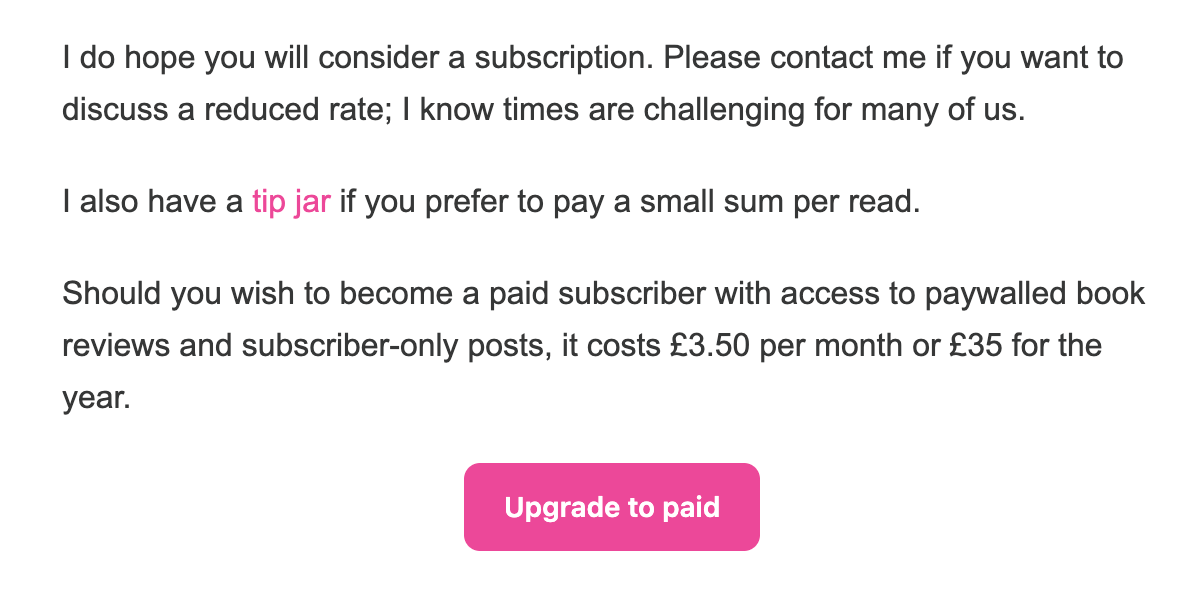
Nic Miller has offered this option for a while on Tales from Topographic Kitchens, calling it “pay as you go” and using the platform Ko-fi to make it available to readers.
✅ Pros:
- Creates another option for readers who don’t want a subscription.
- Gives you a good excuse to fight back the “paywall police” (as The Flytrap editors so perfectly call them).
- Gives your tip jar a purpose and a reason for you to bring it up often.
❌ Cons:
- It’s hard to manage which article to unlock (you have to get them to comment it and email the link back to them).
- There’s no good way to automate this, and if you’re not around when someone wants an article, they have to wait on you.
- You must have gift link ability to make this work.
The tip jar as emergency funding
Tip jars work great as a “hey, we need money NOW” link for people to pitch in. The line between a tip jar and a crowdfunding campaign is mostly window dressing, but if you keep a tip jar running then you always have a way to get this fast funding in without making it a whole extra project for you to set up.
That’s what Marcia Gagliardi of tablehopper did in the fall of 2020 when sponsorship revenue was down. She tossed her tip jar link into the newsletter and asked people to help cover operational costs. According to her follow up post two weeks later, the appeal worked and “many” people contributed.
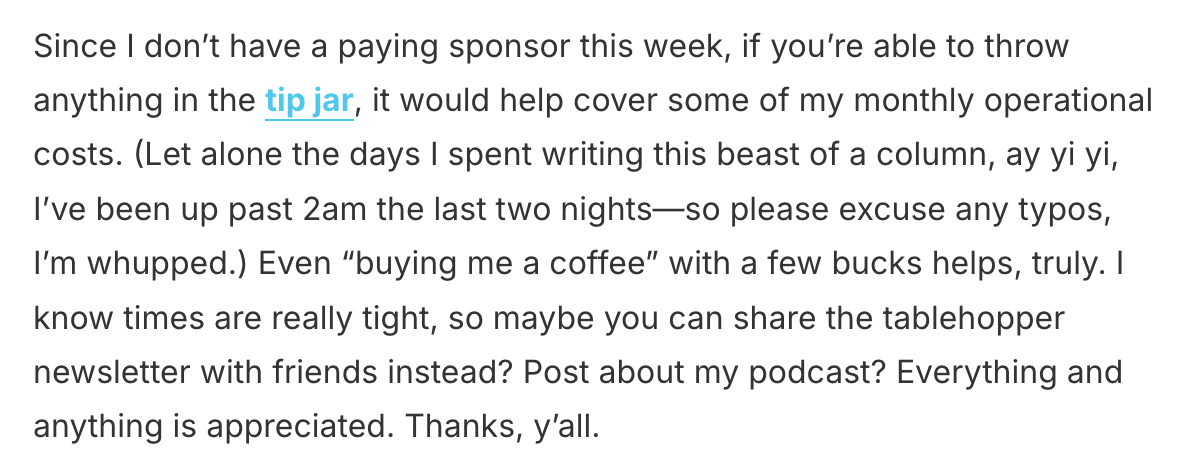
Tip jar platforms like Ko-fi and Buy Me a Coffee both have goal options that turn your page into a crowdfunding-esque fundraising view with a live thermometer. See Angela Hollowell’s tip jar for a good example of how to use those goals to cover a specific purpose.
✅ Pros:
- Set up once. Use it continuously.
- Allows paid subscribers to pitch in more on top of their subscription (which will happen!)
- Promoting your tip jar irregularly will draw more attention to it (meaning not having it in every post or buried in your footer)
❌ Cons:
- If you need a heftier chunk of change (more than $2k), you might want the more robust tooling of a crowdfunding platform.
The tip jar as a “consulting” bonus
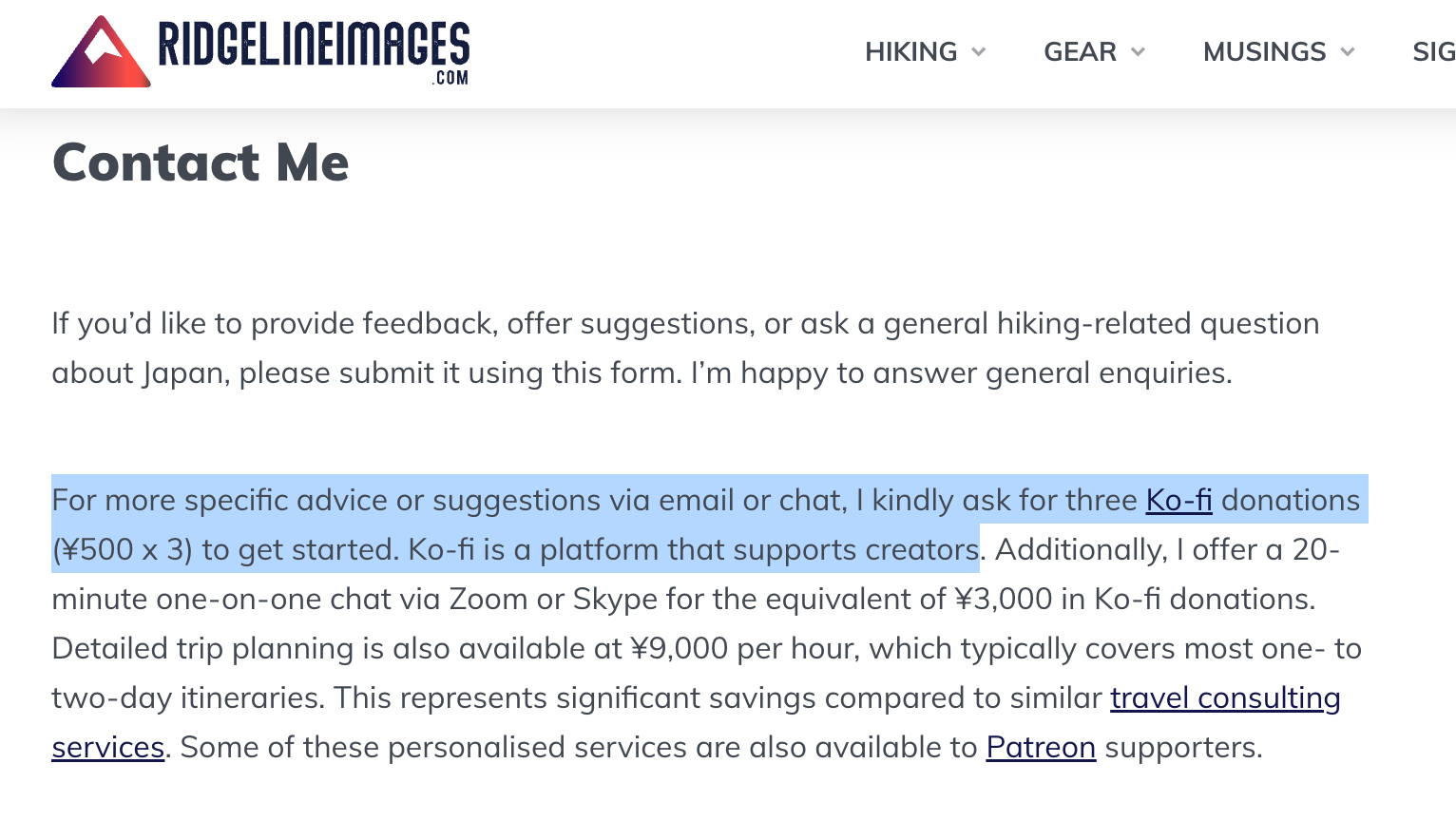
You know those annoying “pick your brain” messages? If you find you’re giving your time to people for free AND you don’t want to have a paid consulting offer, you can use your tip jar as a pay what you want consulting fee.
David Lowe, who runs Ridgeline Images, a site that chronicles the hiking trails around Tokyo, was getting hit up frequently enough for personalized advice and suggestions that he set a donation amount for it: ¥1500 (about $10 USD).
Based on the activity on his Ko-fi page, it seems like a lot of his readers have taken him up on this affordable value exchange.
✅ Pros:
- Compensates you for “quick questions” and “pick your brain” type requests
- Allows you to avoid setting up a consulting practice and delivering services
❌ Cons:
- Undervalues your consulting rate which for most of us is somewhere between $150-2000 an hour! (Though as a person who hates consulting with a passion, I see the appeal of these quick, cheap commissions, especially for a consumer-focused publication)
The tip jar as a one time raise
Want to pay for something you didn’t budget for? That’s where a one time raise comes in helpful. You can promote your one time raise as a campaign (like The 51st did last month) OR you can operate it like a tip jar as Tangle is doing.
What’s the difference? Framing and urgency.
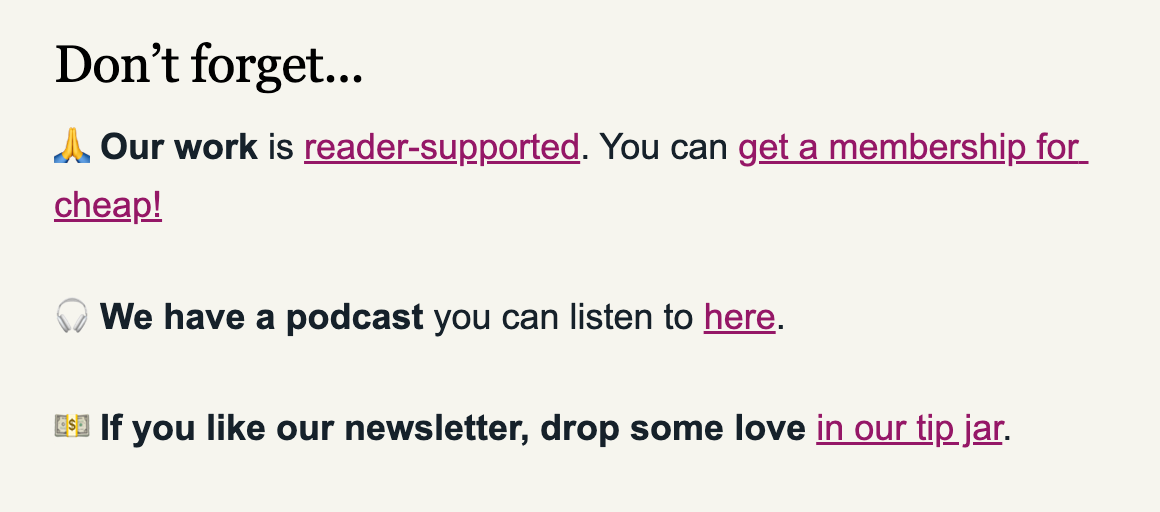
Where The 51st needed $125k to make two full time hires immediately, Tangle is looking to raise $150k to fund their YouTube channel sometime this year. They’ve been running this campaign in the background for months and they refer to it as a tip jar in their newsletter.
Tangle’s been promoting the “tip jar” regularly but it’s taken a backseat to their membership offer which is usually the primary call to action on their newsletters. That’s probably why their raise is going a lot slower than The 51st’s, despite having an audience that’s at least 10x larger. Having just interviewed the Tangle team for next week’s edition, I’m sure this is intentional. Not every call to action can have prime billing and it’s ok to go slower or deprioritize one of your revenue streams.
✅ Pros:
- Makes it more likely that you’ll bring in the amount of cash you want.
- Allows you to capture potentially high dollar donors.
- Motivates your audience to pitch in more than generic support requests.
❌ Cons:
- If you want to raise a lot of money, you’ll need to make your tip jar a loud primary call to action (and that can take away from subscriptions or sponsors temporarily).
- Recurring contributors > one time supporters (but there’s overlap in these audiences).
The tip jar as extra appreciation
You can hold your tip jar out front when you’ve done something notable that you think people will want to financially back on its own.
404 Media recently started publishing their ICE reporting in Spanish because immigration raids in the US are largely affecting a Spanish-speaking or bilingual population. When they announced that they were doing that, they also plugged their paid subscriptions and their tip jar, because there’s an extra cost to translating those stories.
Tying your tip jar into an editorial angle like this is a strong play—much stronger than a footer mention—because it appeals directly to what your readers appreciate about your work and why you need more money to produce it. I don’t normally advise a dual call to action like this (paid subscriptions and tip jar together) but in this case, when used sparingly, it can work well to capture as much reader revenue as people are willing to pitch in.
✅ Pros:
- Gives the tip jar a purpose without putting you on the hook for something new.
- Allows you to capture potentially high dollar donors who want to throw in $500, $1000, etc because they believe in something you’re doing.
- Allows paid subscribers to pitch in more on top of their subscription.
❌ Cons:
- Detracts from your subscription offer (though that’s fine sometimes).
So, what’s your tip jar for?
It’s definitely NOT for reliable revenue but you can lean on a tip jar for bonus cash at any time. Important to keep in mind that you will need to actively promote your tip jar if you want serious money to come from it. A little “buy me a coffee” plug in the footer of a newsletter is not gonna yield much for you. Revenue streams require promotion.
The challenge of your tip jar is finding the right utility for it without taking away funding that could go through subscriptions, services, products or another higher value path. It’s worth experimenting with to see how much promotion it takes to get some real cash flowing through it and then you can decide: what’s YOUR tip jar for?
Want more on tip jars? Read my recap of my $5k summer reader raise.


