


The house always wins, except when the house was built by an intersectional feminist.
Becky Mollenkamp needs to buy herself some time to change how she does business. Rather than launch a new time intensive offer or run a boring fundraiser, she wondered if she could breathe new life into her existing library of products. Use them to fund her next stage of business.
Inspired by the arcades of our childhoods, she created Carnival where participants buy tickets and redeem them for prizes. Prizes include 21 of Becky's ebooks, workbooks, toolkits and other digital downloads. There's a few microservices in the mix like a 1 hour call and a month of Voxer support, but for the most part the idea is to sell the back catalog. If Becky can get Carnival to work as designed, it will serve their community and give them the financial breathing room to figure out what's next for their business. Their goal is to hit $15,000 in tickets sold by December 31.
Becky's making a lot of bets here, but the most intriguing one is: will their community come through to help pull this off? There's no big marketing plan behind the Carnival. In fact, Becky's moving away from social media and she's keeping a light touch on email marketing too. She's doing a lot of personal outreach to make her network aware of Carnival and she's hoping participants will enjoy it enough to spread the word.
Pizza party mentality gets the people going
Built into the premise of Carnival is the idea that the collective—those of us who participate in it—benefit from its growth and therefore, will help hit the goals.
You don't just earn individual prizes when you buy tickets. The more people purchase tickets, the more prizes the whole group unlocks because Becky has set collective milestones along the way where everyone wins. "Guru cliché" bingo at $5,000. A virtual pizza party at $7,500.
Becky's big on collective action. Her membership is called the Feminist Podcasters Collective. She runs Messy Liberation Circle, a podcast and community, with Taina Brown. Her bio leads with related language like "Black feminist thought," "disability justice" and "equity-minded." But collective action isn't just for radical activists. "You remember the school fundraisers where there's a thermometer and usually you're trying to earn a pizza party for your class? I like that collective approach. If we can all reach the goals collectively, we get to unlock extra things along the way," Becky said.
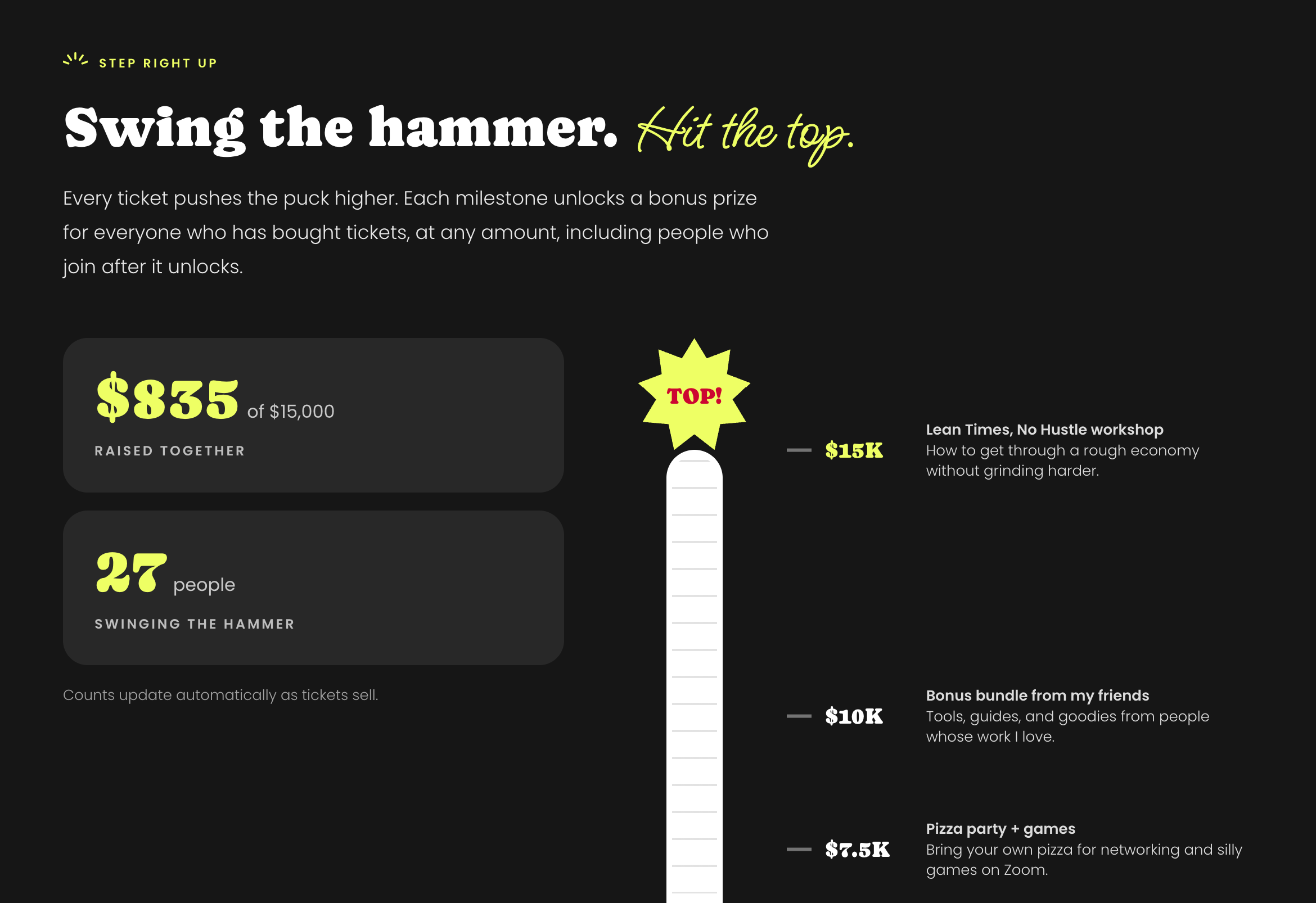
If Carnival is enticing enough to not only buy tickets but to share, this collective action thing can work. Becky's own outreach won't be enough to fulfill the goals of Carnival. That's on purpose because — in order for Becky to get the break she needs to rethink her business — she can't be spending this entire fall selling and executing Carnival. She needs her community to step up and take some of this weight off her.
Not everyone gets Carnival immediately though or knows how to engage with it. Becky said some of her peers have responded to emails saying they were "overwhelmed" by the options. I've also heard confusion when I share what Becky's doing with others, even though it's pretty clear to me why this is interesting and how I might participate. It's novel and novel things require more explanation than copycat strategies. To engage the amount of people Becky needs, they're going to have to find ways to motivate a wider base of support. Becky doesn't just need to persuade the people in her immediate network. The Carnival itself needs to convince anyone else those people refer.
Your ask is a gift for the right recipients
I heard about Carnival from marketer Andréa Jones, who posted about it on Threads, and from Pame Barba, who learned about it in an online community called Old Girls Club (OGC). Becky had posted in OGC but they told me they didn't know anyone even saw their post or did anything with it until we spoke. Andréa is part of Becky's network and she received an individual note about Carnival.
"In the traditional models, everything's automated. In theory, it's hands off. But I think also, especially in the world of AI, it also makes things deeply impersonal. Many of us are used to tuning messages out at this point. I can smell an email sequence a mile away," Becky said.
When she launched Carnival, she turned to her networking dashboard and began emailing people to let them know about it, how they could be part of it and how they could share it. She's got 500 people in her networking dashboard, 200 of which have filled out her networking form with their preferences for keeping in touch. There's a much smaller group that Becky calls her "inner circle" — people she talks to more regularly — those are the people she's turning to for help reaching the right audience for Carnival.
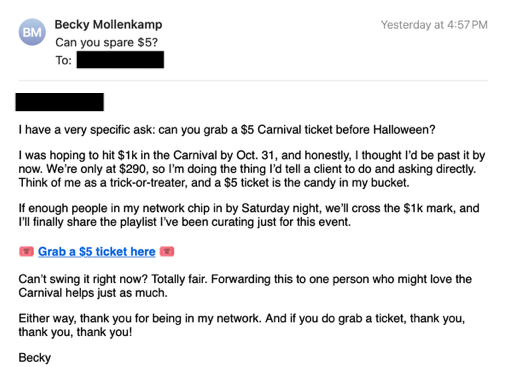
Becky told me she's emailed her inner circle twice about Carnival and she plans to keep emailing them about twice a month until the end of the year. Personal emails can be emotionally harder to send than a mass email, but Becky says they can be "a gift" to the recipient. At least, that's how she sees it when others reach out to her with asks. If the ask is clear and specific, it offers you an opportunity to support a peer and be part of their success.
Her primary ask was buying a $5 ticket and the secondary ask was forwarding the email to one person. This is a nicely specific request because she's seeding the dollar amount someone should pay. People can always pay more but they also don't have to think at all. They can just do what Becky asked. And the forward request is smart too because it's not "forward this." It's "forward to one person." That's a much easier ask to fulfill than please come up with a plan to spread the word about my thing.
What happens if we miss the goal
The goal for Carnival is ambitious, given how many people Becky is personally inviting to it. Each one of them really needs to take action by buying and sharing. I love that they don't want to approach this by loading up work for themself and slamming their audience with messages, but I also wondered what happens if the collective doesn't come through as they hoped.
"If I don't hit the goal, I'll be no worse off than I am now. If it succeeds, I will be able to breathe. I will feel way more comfort in being able to have that spaciousness to figure this out," Becky said.
She's already making changes to scale back her coaching work and she's working to figure out what will replace that income longterm. Carnival is gap-filling income, but if it works, it could also prove that people can come together to engage with business products and services in a more communal way. Becky could reuse Carnival or build off the idea to make other kinds of participatory products beyond memberships, which she already runs.
I loved Becky's Carnival as soon as I saw it because I believe more of us need to pay each other to create cool stuff. It's amazing how much you can change someone's life with $5 or $10. And what Becky's doing here is bigger than financially backing interesting entrepreneurs. They believe their community wants to see this project succeed and that that community will work together to make it so.
The prizes are nice. The milestones are clever. But more than getting something back for my $25 worth of tickets, I want this to work for Becky because that means turning to your network is a viable channel on its own. For those of us exhausted by the demands of modern marketing, this project is a rejection of the template. We might not need so many mass emails or social posts or webinars or whatever else we've been told we need. We definitely don't need big tech intermediaries to facilitate our interactions. We just need to reach out to each other with a smart ask.
With Carnival, the rules are upside down. The game is rigged for the players. Every player wins a prize and the more players play, the more prizes everyone gets. There are no losers here. But will the house win too? We have 53 days to find out.
We'll be checking back in with Becky in a couple months to see how the rest of Carnival went but you can participate now by grabbing a ticket or telling a friend.
How have you survived a period of transition in your business? Share your thoughts in the comments.


