July 4—This story includes two corrections from my earlier post. 1) ThriveCart did send some customers emails about the outage. 2) The AWS outage possibly affected one other company.
July 6—Updated this story to include ThriveCart's CEO postmortem message which they released today. Also updated the story to include reports that ThriveCart customers are getting blocked from the official customer support Facebook group. See more at the bottom of this story.
July 7—Added what ThriveCart support said about why some customers are being blocked from their Facebook group
Another exodus of ThriveCart is brewing after their service went down for several hours on Friday due to an unplanned update to their AWS database. AWS hosts nearly 30% of the internet so it's usually more obvious when they cause a problem, but this was not a system wide outage. There were no widespread reports about other apps being down today. It mainly seems to have affected ThriveCart and possibly Instacart.
ThriveCart customers took to Threads starting around 8:30am Eastern time to share that the platform was not functional.
- SEO pro Nina Clapperton said they couldn’t sign in or open their cart on the last day of their launch.
- Pinterest expert Meagan Williamson reported that they saw a purchase come through only via their end processor PayPal, implying that ThriveCart did not document the transaction at all.
- Systems strategist Ashley Tindall wrote that her client emailed her at 6:26 am ET because they "had been trying for several hours to access a course in ThriveCart learn and couldn’t."
- Systems Over Stress’s Ashley Rose said she was trying to buy from someone else hosted on ThriveCart today and their checkout was down.
Online business owners once loved ThriveCart for their one time pricing plan, their affiliate system and their easy upsells but problems with their platform have been mounting for two years. This outage is the latest in a series of bad service quality with TC users saying that their customers can't check out, that their members get kicked out of their portal for no reason, that their products spontaneously stop working or that they can't actually edit their products—all before Friday's downtime.
The problems began around the time ThriveCart took a $35M investment led by private equity firm LTV SaaS Growth Fund. Private equity entering the ring rarely ends well for customers. On LTV SaaS Growth Fund's website, they state that, "LTV SaaS Fund seeks medium-term investment opportunities, with a return rate of approximately 174% over a 3-5 year term." You've never heard of the other companies this group has invested in. It's mostly Shopify apps. We are now 3 years into their investment with TC and the pressure is on to deliver that return. ThriveCart has had two different CEOs since they took this cash, with Ismael Wrixen moving into the role last year.
Under Wrixen's leadership, ThriveCart has made at least three acquisitions—PiktoChart, VBOUT, and Stealth Seminar—their first product acquisitions maybe ever in the company's history. Product acquisitions can be good for customers if integrated well, but they can also create an unstable and unwieldy platform. Whether or not the acquisitions are causing a technical problem, it's clear ThriveCart's leadership is focused more on growing to appease investors than actually serving their core audience. All tech companies deal with outages and bugs. The issue with ThriveCart is that they're not just failing at tech, they're unable to properly communicate with customers.
ThriveCart did send two emails to customers on Friday. The first went out at 11:08am ET (at least 6 hours after the incident began) to notify them about the outage. The second was at 3:32pm ET to let customers know it was resolved. Several customers confirmed that they received these emails, however I am a ThriveCart customer and I received nothing. A few others reported they didn't received any emails either. Melissa Litchfield, who runs an ad agency for online businesses, said what might have happened is ThriveCart lets you unsubscribe from system notifications, treating them the exact same as their marketing emails. In my case, their social team said my email was bouncing even though I checked my spam and filters and that same email is what I use for every other app. ThriveCart does have a status page which reflected the outage, but you wouldn't know about that if you didn't get the emails because they didn't bother posting it on social media to ensure their customers saw it.
This is just the tip of the iceberg for ThriveCart's communication fails.
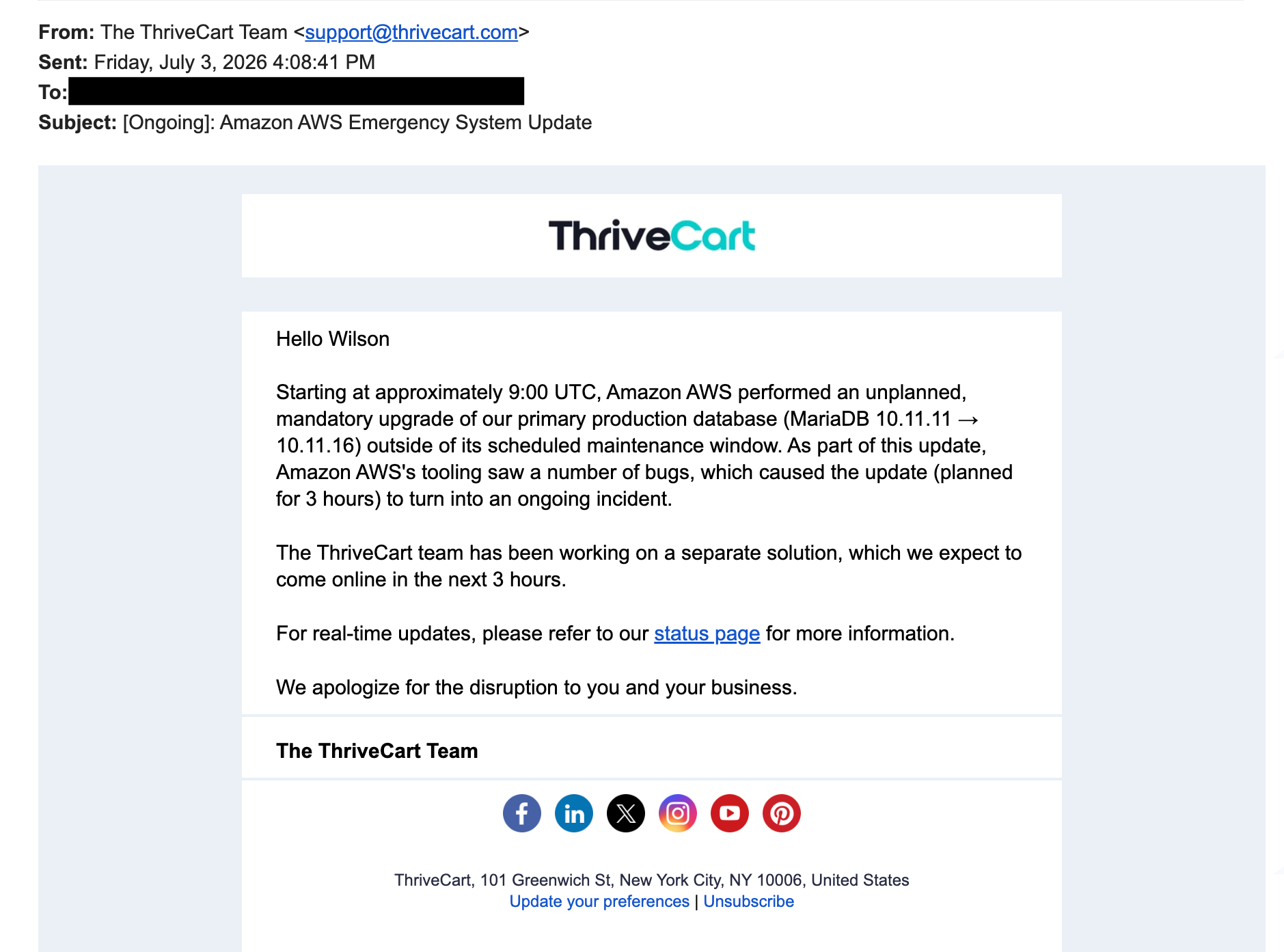
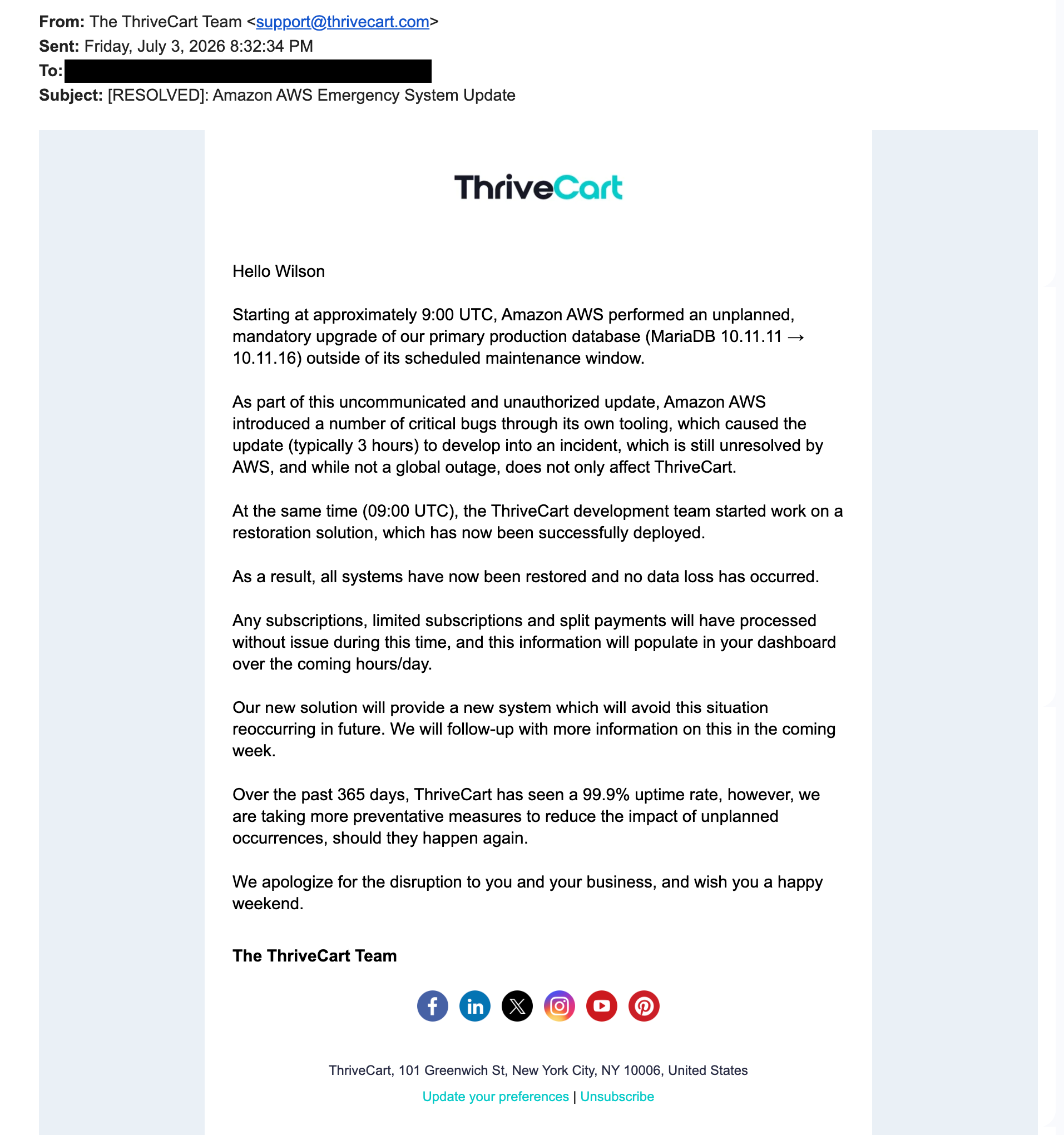
ThriveCart's communication emails on Friday, July 3
The ThriveCart social media team spent most of Friday fact checking their customers' complaints instead of actually addressing them. Meanwhile, there were zero proactive posts about what turned into 10-11 hours of platform downtime nor any status updates until it was resolved at 4:19 pm ET. While ThriveCart customers panicked in public about their blocked launches, lost sales and unhappy clients, the TC official social account was posting embarrassingly bland nonsense that had nothing to even do with their product.
In all of their communications across social media, email and the app itself, ThriveCart doesn't seem to grasp how critical their tool is for small business owners. They have been known to delete unwanted posts in their Facebook support community and they never take any responsibility for their homegrown problems. Meagan Williamson summed it up by saying, "Every single time there is a technical problem, the team is always pointing the finger at every other app, company or touchpoint."
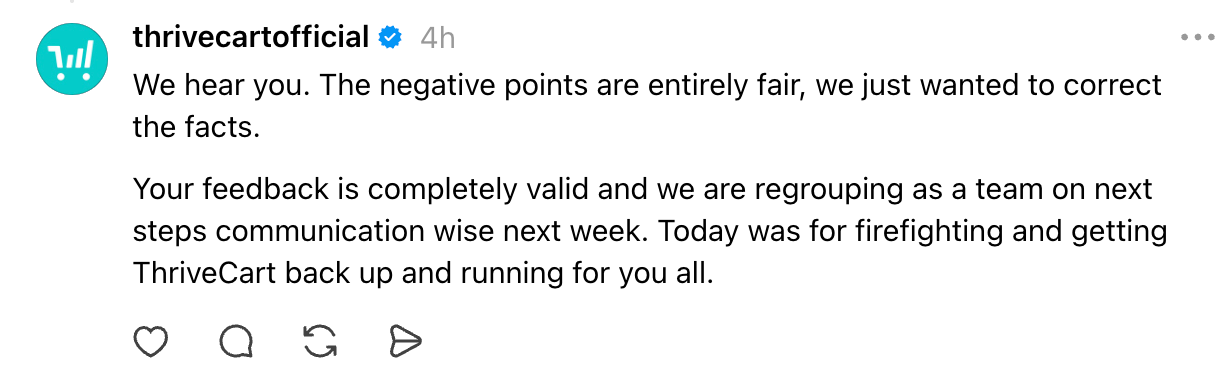
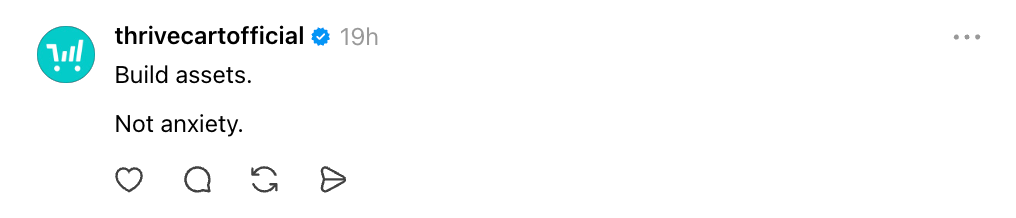
One of ThriveCart's replies to a customer and one of their posts from Friday during the outage
It's a stark contrast to Flodesk, which also has technical problems, but who does a substantially better job at communicating with their customers. Since both brands are active on Threads, it's interesting to watch one rise and the other fall, mainly due to the level of trust they've built with their audience. Flodesk can do no wrong right now (even when they do something wrong) but ThriveCart has spent the last couple years losing any goodwill they ever had. In the wake of hundreds of reports that basic functions of their platform aren't working, they give lukewarm apologies or share vague plans to "do better" with no follow up action.
One company knows how to instill confidence in their brand and make good on their promises. The other is not going to make it to through the next decade, unless they make a drastic leadership change. Thanks private equity.
Small business owners are over it and Friday's outage prompted many to declare they were moving (or had moved) their checkout system. Colie James, a client experience strategist, moved to Teachery in the time it took to watch two Love Island episodes. YouTube expert Jamar Diggs switched to Dubsado before Friday's incident and was sharing his experience with entrepreneurs searching for solutions. Marketing strategist Victoria Boyd now uses beehiiv for digital products and Heartbeat for community-related offers. Other alternatives people shared included Flodesk Checkout, Shopify, and SamCart. I would also add UK-based Payhip, which adds a fee if you’re on the free plan but has paid plans with low or no transaction free.
In response to my earlier post about this exodus, ThriveCart's social team incorrectly claimed that Colie, Jamar and Victoria were "paid by other platforms to promote them," which is indicative of the kind of blame games they love to play. They are referring to the fact that once someone makes a switch, they might share an affiliate link for their new platform. There's no outside campaign here to get people off TC. ThriveCart is losing all these customers on their own by being incompetent in every aspect of their operation. Their team ought to be hard at work trying to win back some trust instead of fact checking blog posts.
It's wild to watch such a popular platform fall from grace, but two years into this decline, ThriveCart is not showing any signs of improving their reliability or their customer service. It would not take much to turn this boat around, but they seem incapable of doing that under their current leadership. Between their private equity investment, their bloat-adding acquisitions and their inadequate communication strategy, the writing is on the wall that this is the beginning of the end. Small business owners would be smart to make their exit plans before the next crash out happens.
Update 1 (Monday, July 6): ThriveCart released a public postmortem detailing what they will change in the wake of this outage and their handling of it. Based on a search of the blog, it's the only public postmortem they have ever shared. The blog post is mostly about technical updates but the video that CEO Ismael Wrixen recorded acknowledges that they had a huge communication breakdown with customers and lays out a few fixes including "optional automated email, SMS, and RSS notifications" and a "Customer Advisory Council." It's not nothing. It is the first time we've seen a promised, tangible improvement to the communications (and maybe even the tech) happening at ThriveCart. It's still semi-weak. A Customer Advisory Council wreaks of useless focus group energy. ThriveCart has direct access to their customers on social media at all times. They need a better social strategy for their Facebook Group and public social channels. We'll see if they make strides to do that.
Update 2 (Monday, July 6): ThriveCart is blocking its own customers from its Facebook support group after last week's outage outrage.
ThriveCart customers on Threads are reporting they've been blocked from the customer support Facebook group. I went to check if I could get in (as a ThriveCart customer who was already in this group) and I've been blocked too.
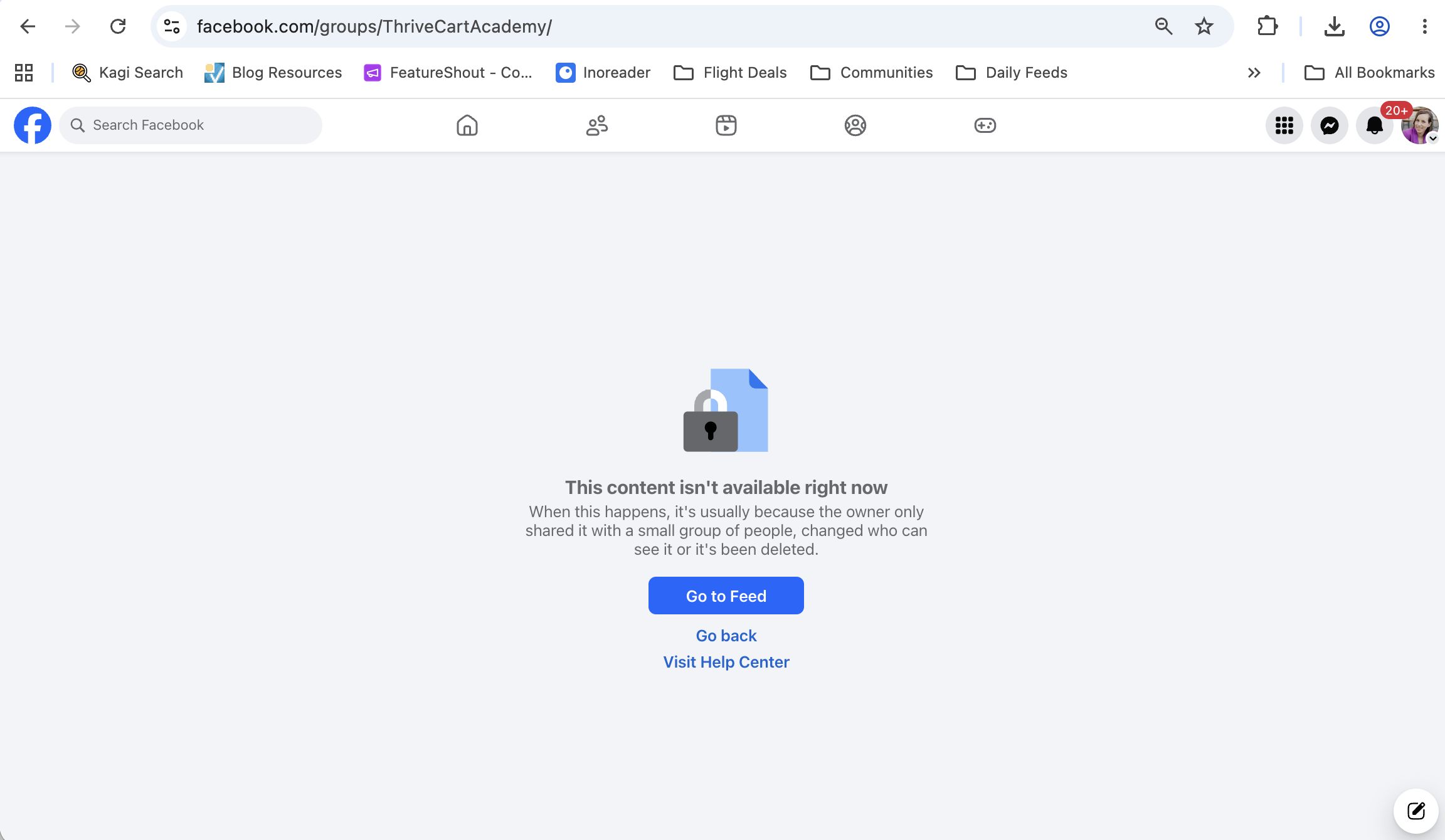
Web designer Cristina of The Lovely Geek speculated that they had nuked the group but systems strategist Ashley Tindall said they'd both probably been blocked by ThriveCart's admins. None of the three of us had posted any messages to the Facebook group within the last few days. Remember their promise of better customer communications from earlier today? Looks like that's going great!
I reached out to ThriveCart for comment and will report back if I hear why we're getting locked out of the group.
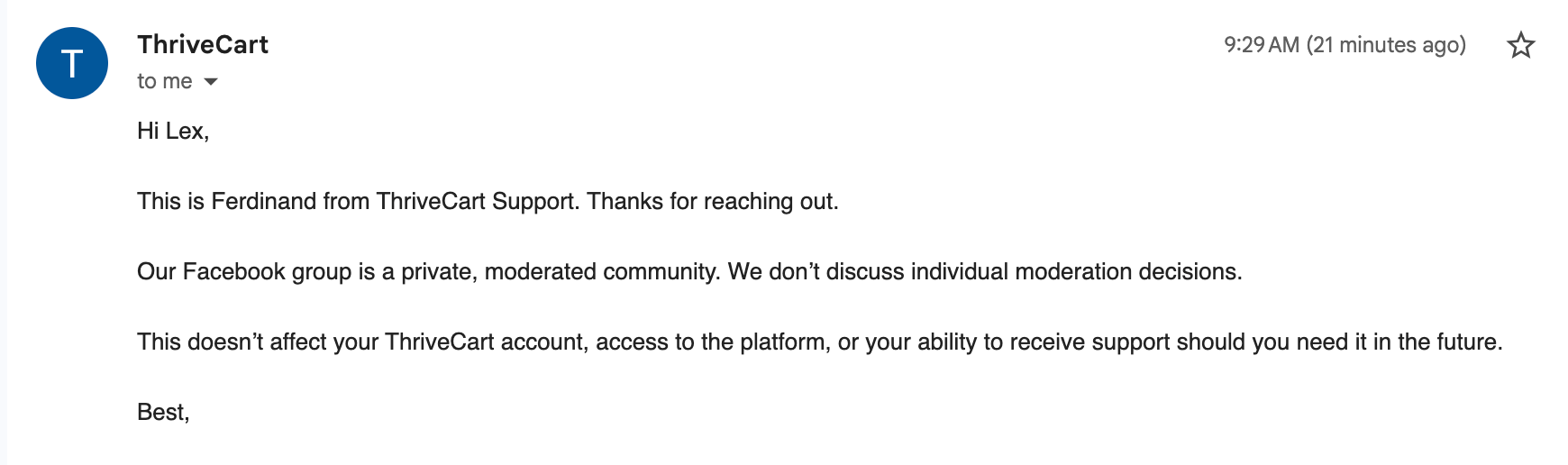
Update 3 (Tuesday, July 7): ThriveCart Support emailed me back in response to my question about "Why am I and other customers blocked out of the Facebook support group?"
They said "Our Facebook group is a private, moderated community. We don’t discuss individual moderation decisions. This doesn’t affect your ThriveCart account, access to the platform, or your ability to receive support should you need it in the future." I read this as confirmation that myself and others are being deliberatively blocked by ThriveCart admins. I have never posted in this group and the two others who reported possibly being blocked said they had not posted recently either.