

Disclaimer: This story features my own strong opinions about why I think Patreon is a bad choice for a subscription business and they are just my opinions. Plenty of creators like Patreon. I am not one of them.
I exhale a heavy sigh when I learn a creator is on Patreon and they want my help growing their paid subscription. Patreon is one of the two worst places to be for subscription growth. The other is Substack but everyone knows Substack's got problems. Patreon has a much better reputation as a place for alternative artists and cool podcasters, thanks to founder Jack Conte's origin story as a rock star. But it's a deceptive facade because once you go to Patreon, YOU CAN NEVER LEAVE. Well, you can leave, but your subscribers will not come with you.
I don't think Patreon is a good choice for your business, but now I'm wondering if their own business is faltering. Patreon laid off 20% of its staff today. 20% is a big layoff and it's hard to buy that that's all about AI optimization, especially at a company that doesn't ship much. The numbers seem to indicate that Patreon's own growth might be flattening out this year and, while I think creators who already operate on Patreon are ok there, it might not be the right time to join them.
Patreon locks your subscribers to their platform. You can't take them with you.
Patreon runs payments through their bank account first, unlike the vast majority of platforms out there where payments go straight through to your processor. Your backers pay Patreon and then Patreon pays you. This is becoming more common practice in tech—tip jar platform Buy Me A Coffee switched from fully integrated Stripe to Stripe Connect within the last year, digital product shop Gumroad changed their payouts to a similar setup—but it's a worse deal for creators.
This type of payout system has two major drawbacks for you: it slows down your payouts and it takes your customer relationships away from you.
You can choose your payout method with Patreon including Stripe, PayPal, and Payoneer, but what's happening is that Patreon is just transferring you a lump sum of money through that provider when you request it. That's quite different from beehiiv, Ghost, Substack, Buttondown, Ko-Fi or Payhip where you connect your own payout account and every single payment goes immediately there.
Why does that matter? Because you control the customer transaction and you can take it with you. If you want to move from Substack to Ghost, your subscriptions can be transferred invisibly—without any action needed from your subscribers—via a Stripe migration. Also, your payouts are daily and automatic.
With Patreon, you can decide you don't want to be there anymore, but your subscribers can't be migrated because you don't own that relationship. Very few creator platforms lock you in this way. Patreon, Buy Me a Coffee, Gumroad and Stan Store are the only ones I can think of. That leaves a lot of creators nursing their dwindling Patreons because they aren't ready to give up the few hundred bucks they're making there but they moved their core business elsewhere. They've tried getting those last subscribers on Patreon to move too, but it requires every single one of your patrons to cancel and resubscribe elsewhere. Unlikely.
Patreon is just as bad for subscription growth as Substack. Maybe worse.
My beef with Substack has always been two-fold: they're monopolizing media and they have shitty subscription tooling. Patreon does not have the first problem but they do have the second.
Like Substack, Patreon doesn't give you much automation capability or control over your tiers. You're obliged to follow their model. Group subscriptions? Not a thing in Patreon. Want a welcome sequence? You can't have one! How 'bout a delayed promo offer? Nope!
For a long time, I thought that, since Patreon has an API (unlike Substack), you could hook it up through Zapier and make your own automations. But in running a recent paid subscription growth cohort, I learned their API only works for PAID subscribers. That's a massive limitation and you've got to believe an intentional one to keep you from moving your audience elsewhere.
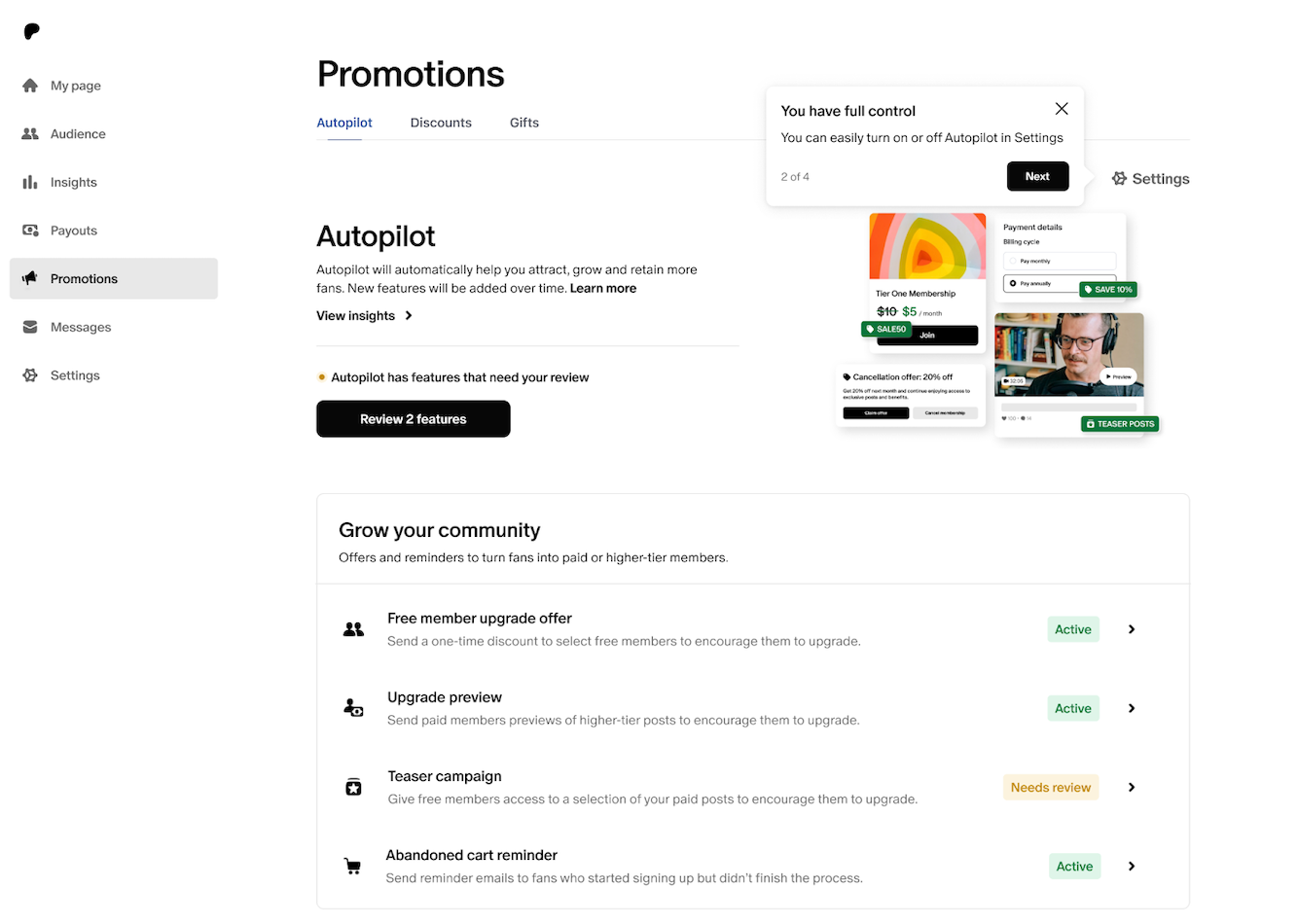
Patreon's built-in automations are SLIM. You've got one welcome email, one paid welcome email, a teaser campaign, abandoned cart emails, a cancellation offer and expiration emails. These are templated and that would be ok if they were using industry best practices, but in my view, they're not. You need sequences—multiple reminders—in nearly all cases. You also need to be able to message by tier via automations. One-off blanket emails are not as effective. It gives you only one generic chance to upsell or win back. The rest of us running subscription businesses are using multiple emails to do this. As subscriptions become more prevalent, I see custom automated sequences as a required feature.
You also have virtually no layout control of your Patreon. This is on purpose and it's probably why a lot of creators gravitate there—they don't want to fuss with design. But what if you want a "why pay" page to help convert people? Or a "paid subscriber FAQ" page? The only way to have these is to use your featured posts like Max Read did, but that's pretty limiting.
What you are left with is having to drive your own subscription sales and win backs every week on Patreon. You have to run campaigns. You have to get smarter about what you paywall. You have to test different CTAs. It's true that all of us running subscription businesses have to do that, but Patreon gives you way less tools to do it and they don't let you automate nearly any of it.
Ok, they sound bad for my business but what's up with their business?
After today's layoff announcement, I looked up some of their growth metrics.
Patreon's valuation in 2021, when they did their last venture raise, was $4B. Five years later, it's closer to $1B. Valuations can be fickle because they're based on market vibes but that's quite a drop.
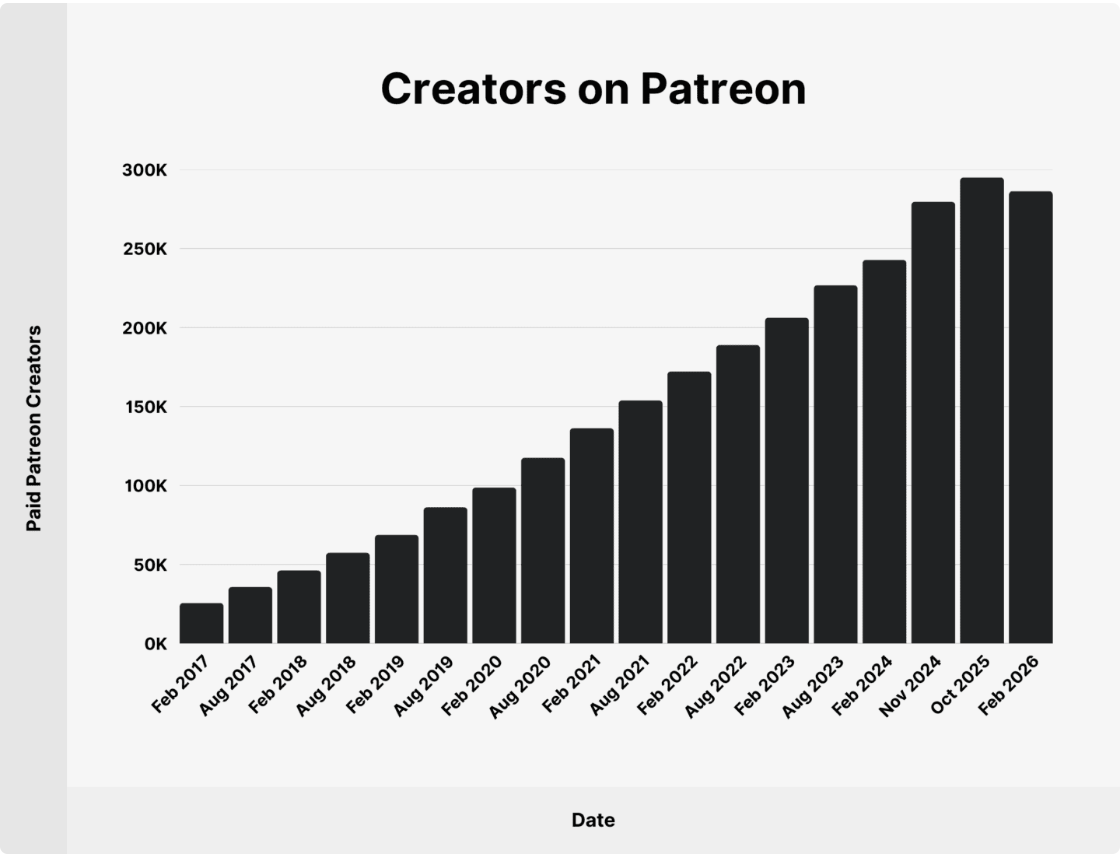
What about their creator growth? According to Backlinko and Graphtreon, active paid creators on Patreon is starting to show a small dip in 2026. See their chart below.
Those same sources indicate Patreon's monthly creator earnings have been flat for years now. Roughly the same from 2022 to 2026. These charts exclude "hidden earnings," meaning creators whose earnings are not shared publicly for some reason, even in aggregate. And what Patreon chooses to give the media is more selective, like this story in Variety that Podcasters Earned $629 Million in 2025 (up 33% from 2024.) $629M divided by 12 is more than twice the numbers that appear on these charts so it's hard to know what data to believe, though Graphtreon literally exists just to plot Patreon data. I buy the trend because they track Patreons daily but I maybe don't buy the exact payout numbers.
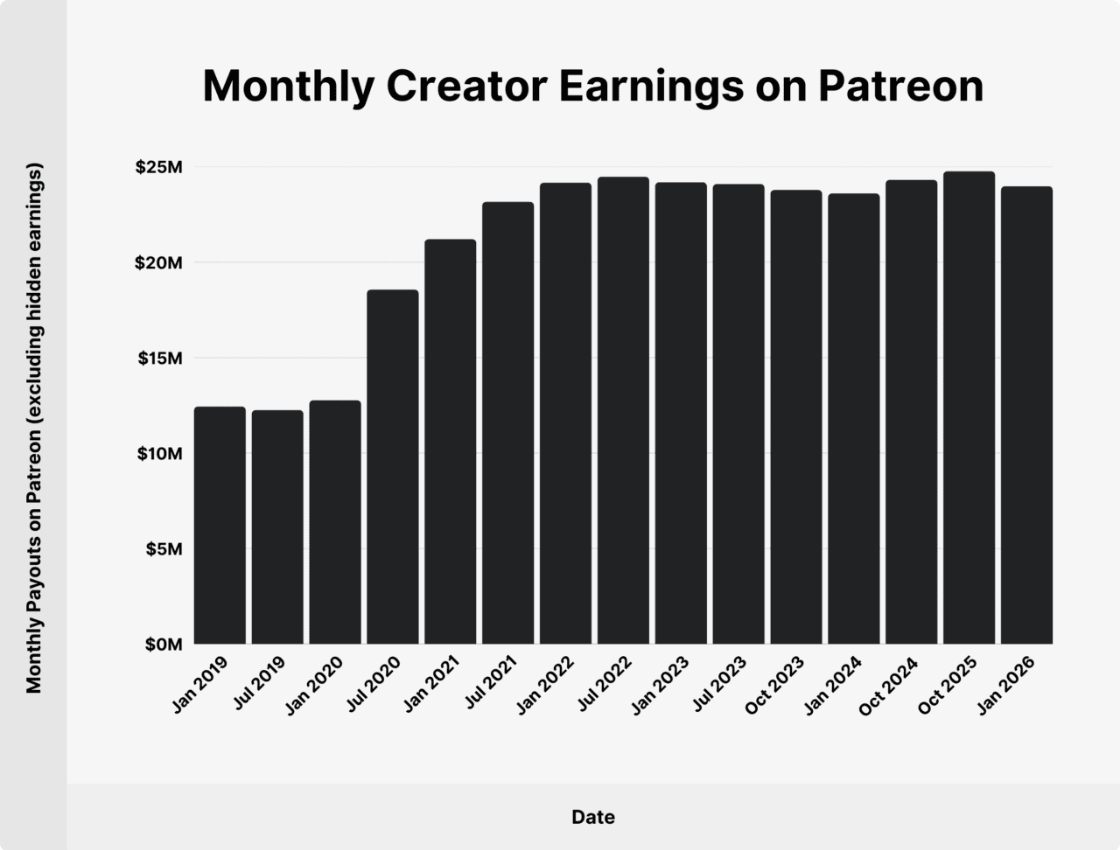
Brian Dean who put together Backlinko's report on Patreon came to this conclusion, "The membership platform has experienced strong user growth during the pandemic, but hasn’t grown much over the past few years."
That's my read too. Today's layoff seems to indicate a downturn is coming. If you're not already on Patreon, I'd go elsewhere. That's been my recommendation long before this layoff. It's a mistake to leave Substack for Patreon.
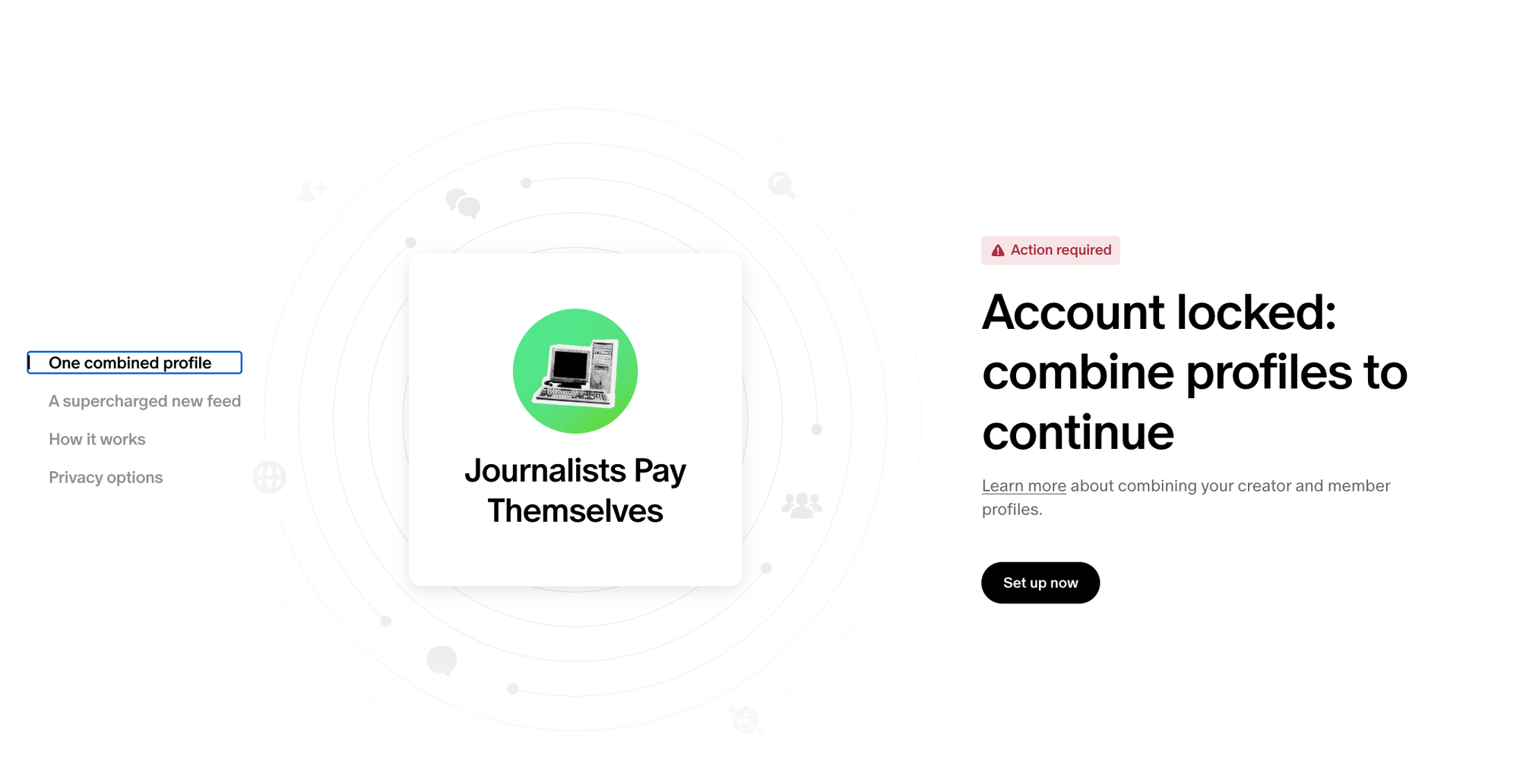
If you are already there, prepare to weather a storm of minor inconveniences. I don't think Patreon is a total disaster but sometimes they pull shit like blocking us until we mandatory merge our profiles or changing up payout terms. They definitely make it harder to run a creator business, but not impossible. Some people even say there's advantages, though I've never heard what those are.
If you're looking for alternatives to Patreon, check out my post about which platforms to use and my video on how to get a paid subscription up and running.
One last thing I'll add is that Ernie Smith who writes Tedium reminded me today that Patreon owns Memberful. Memberful does not suffer from any of the problems Patreon does on the creator side. It has strong tooling, albeit it with hefty fees, but they might be part of this company layoff (that's not being reported, so we don't actually know.) Ernie also pointed out Patreon has never integrated Memberful or made efforts to merge them, which would actually fix A LOT OF THEIR PROBLEMS, though it would suck for Memberful customers. Best case scenario is Patreon learns from Memberful, integrates with them and empowers Patreon creators to use their automation and customer relationship tools, without destroying the gloriously decoupled marketing suite of Memberful.
I do think there's hope for Patreon in some distant future but I'd steer clear until they get their shit together.
Are you on Patreon? What's your experience been this past year?


