

Brought to you by the fine folks at Outpost for Ghost publishers. Get more subscription revenue for your Ghost publication with Outpost 🪐

Update: Read this story on The Chernin Group, one of Substack's lead investors (2/4/26)
Whenever I hate on Substack, the top question I get asked is “Well, what platform should we be using?”
This is the wrong question.
Are we building independent media or are we building platform-dependent media?
We should not be looking for answers to our business problems inside a platform and we sure as hell should not be looking to Substack to save us from media collapse.
Substack’s latest funding round crowned them a tech unicorn with a valuation over $1B dollars. It’s never been a scarier time to be associated with their platform.
I’ve talked a lot about why Substack is bad at paid newsletters, how they steal your audience and your revenue and how they’re disempowering writers.
Now, I want to talk about what I think will happen with Substack next and why it’s time for me—and maybe you—to divest altogether.
How Substack’s monopolizing “independent” media
Substack has made their brand bigger than yours. And the press has played right into their hand.
“Terry Moran launches Substack after sudden ABC News departure”
“Yes, Eater New York Is Now on Substack”
“Jim Acosta Heads to Substack After CNN Exit”
Terry Moran could have launched (his media brand), but he launched “a Substack,” according to Axios. Jim Acosta could have headed (out on his own), but he went to “Substack after CNN,” according to The Wrap. Even journalists themselves will say “my Substack” instead of naming THEIR OWN BRAND.
“Read my Substack” is a now ubiquitous catchphrase that leads everyone from the New York Times to your casual reader cousin to conflate independent media and Substack as one inseparable entity.
Substack operates as an ecosystem. This is touted as their greatest advantage—the so-called writers’ network—but it has also resulted in a singular feed that has the capacity for deciding whose voice matters and which posts should get seen, much like Twitter, Facebook and TikTok. All it takes is one board member to say, “you should really be showing more messages about XYZ” for Substack’s feed to look completely different.
We’ve seen this movie before with Twitter and Elon Musk. With Facebook and Cambridge Analytica. With TikTok and Trump. A single point of control will be controlled.
Substack conned their way to cultural relevance
Substack has gaslit writers into believing the platform will operate their business on their behalf. Their marketing uses language like “growth on autopilot” and “magic dust” that has successfully wooed many writers who don’t want to learn the media business into their arms.
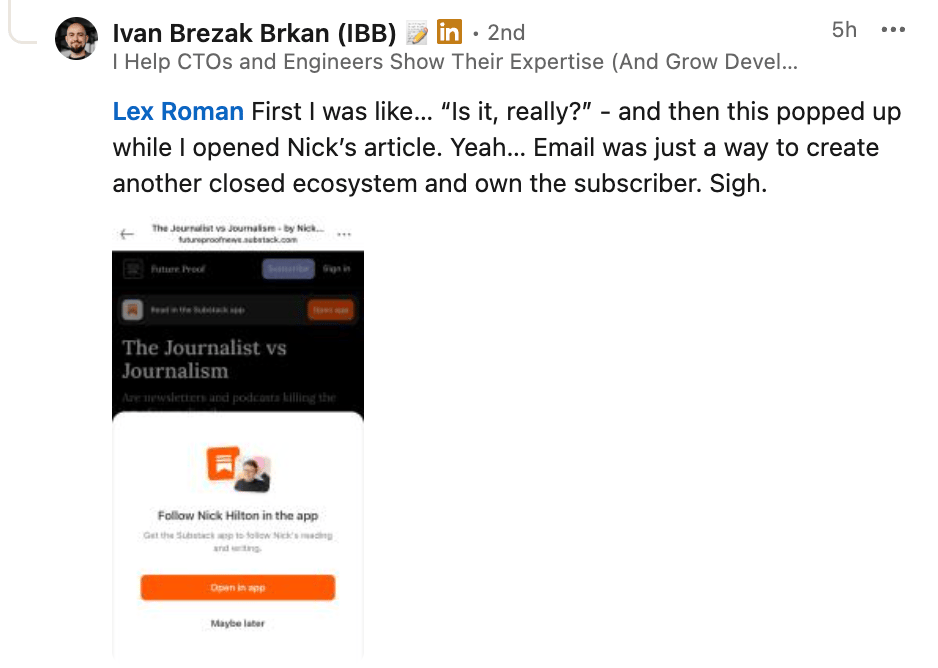
Is Substack helping writers grow their own publications? We can’t actually know that.
Substack has made their analytics close to useless, overcrediting themselves for your growth. They create a public ghost profile for EVERY ONE OF YOUR READERS without their permission. That means if your newest reader has ever subscribed to another Substack publication, Substack takes credit even when YOUR MARKETING EFFORTS actually brought them in.
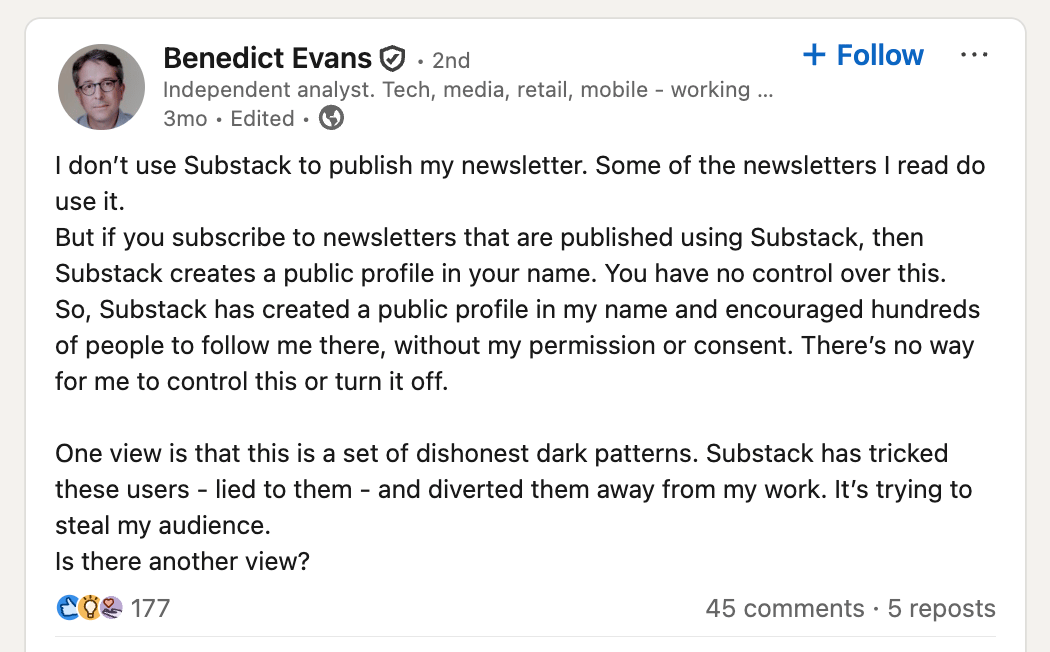
(Interestingly, Benedict Evans was a VC at Andreessen Horowitz when they first invested in Substack by leading their Series A round.)
We don’t have good data on Substack’s actual market share because email marketing and newsletter media are often mixed together in trend reports. Many of these reports will claim MailChimp (sold to Intuit for $12B in 2021) has the most market dominance in the email realm, but I don’t think that can possibly be true when it comes to journalists and media creators. Substack also needs to be compared to podcasting and livestreaming platforms now. It’s not just an email platform. It’s social media, newsletters, podcasting, livestreaming and group chats in one.
Substack’s metrics do not seem to indicate that they have control of the indie publisher market either. They have 50k paid newsletters, compared to beehiiv’s 110k total publishers. Supposedly, their annual revenue is around $45 million, but they’re still not profitable, compared to Ghost, which has been profitable for years.
So, why is Substack now valued at $1.1 billion dollars?
Because legacy media and the political class are BOUGHT IN.
Substack successfully swindled a critical mass of the media names and it’s now seen as the de facto landing place for legacy media pros like Jen Rubin, Mehdi Hasan, Paul Krugman, and Joy Reid. Even The Washington Post wants in.
Politicians are also flocking to Substack, with RFK, Tulsi Gabbard, Pete Buttigieg, John Reid, Matt Gaetz, Mike Huckabee, Hakeem Jeffries all publishing there. The State Department posts official government communication there.
Not to mention brands starting to open up shop there too.
In short, Substack may not be generating enough actual capital, but they have scammed their way to a significant amount of cultural and political capital. This new valuation is betting they can turn that cultural capital into a massive payout for their investors.
My predictions post Series C
Substack’s Series C round brought in two notable new venture capital firms: The Chernin Group, founded by Peter Chernin, former President and COO for News Corp, and BOND, started by Kleiner Perkins alum Mary Meeker.
BOND Capital was founded to focus on later stage investments. Substack is an unusually risky investment for them and one of the few media-centric ones. Partner Mood Rowghani is joining Substack’s board.
The Chernin Group is more familiar with the media business, having invested in Barstool Sports, The Athletic, Crunchyroll, and Fullscreen. Chernin’s media background and connections are a big asset for Substack’s flailing founders.
Both firms are known for betting on brands that already have traction, and since Substack’s business metrics aren’t impressive enough to warrant a $1B+ valuation, BOND and Chernin must’ve seen fairly “sure bet” potential for the immense cultural pull Substack has to start printing a helluva a lot more cash for its investors. Or at least, they’re gonna make it so.
How is Substack gonna get to that exit? Here’s five predictions.
- Advertising is already being reported as the next addition to the Substack ecosystem, because it’s the fastest way for them to make cash. We could see programmatic ads across Substack where publishers share in a tiny fraction of revenue, similar to YouTube’s model. Or they could try to copy beehiiv and create an advertiser marketplace, which is harder to pull off because it requires individual publisher adoption and thus, would be a slower path to revenue.
- AI-generated content is coming. MORE AI is the mandate of Silicon Valley right now and Substack’s new investor Mary Meeker is all about it, as a financial backer of OpenAI and Meta. Substack’s already setting the stage to pretend their publishers asked for AI tools. They might use AI to generate compound publications that pull from actual Substack writers (kind of like what Spotify does with playlists). Maybe they’ll create whole new publications using AI or they could always just flood the feed with AI summaries a la Google.
- Co-founder Hamish McKenzie is probably gonna leave. There’s much speculation that leadership will be replaced (not atypical for growth stage startups) which could mean Chris Best too, but Hamish has already been moonlighting as a journalist again. I think his ego has gotten too big to be a no-name founder behind a brand when he could be the brand.
- Focusing on big media names with big audiences. This has always been Substack’s main growth lever and it will continue to be paramount for them. They will lean into more partnerships with outlets like The Washington Post, The Telegraph, Eater and any other established media or corporate brands who want to work with them because it brings audience, credibility and revenue, especially on an ad-enabled platform. Big media connections is where The Chernin Group is gonna come in handy and more crossover between their existing holdings and Substack is highly likely.
- Keeping the platform closed. Substack publishers won’t get a public API or any integrations, maybe ever. beehiiv’s founder Tyler Denk made an important comparison that Substack is like Amazon and beehiiv is like Shopify. Substack and Amazon prioritize building their platform, their brand and their userbase. Shopify (and Tyler is saying beehiiv too) helps brands build their businesses with their own websites, domains and customer bases. Substack will remain a closed system.
I don’t see them adding a tip jar, pay per article or ecommerce capabilities anytime soon. Those don’t play into the games of either printing more cash fast OR building more cultural dominance. Unless major brands want to set up mini-stores there like TikTok, then this could change.
I also don’t think they’ll start bundling writers together. It’s not much of a revenue play as it would likely lose them money, given that they couldn’t charge that much more than an individual publisher would. Netflix costs $8 and Spotify is $12. Once you get into the platform pricing game, it’s all pretty low cost. It’s also not much of an audience play because a paying customer would already have to be a fan of at least one Substack publisher to even care about this.
My most cynical self thinks that BOND and Chernin aren’t really that concerned with proving that Substack can generate more stacks of cash—though surely they want that. Instead, their bet is on the massive political role Substack is starting to have and how valuable that is to the right rich people. Their path to an exit doesn’t only include an acquisition or an IPO. They could also sell Substack to a kooky billionaire who wants to own more of the media.
Billionaires like Elon Musk who bought Twitter for $44B and Axel Springer who bought Politico for over $1B have shown us that revenue and buyout number are not 1:1 and if there is political control to be had, there’s a sale to be made. I could even imagine Zuckerberg wanting Substack in his portfolio as Meta’s empire loses relevance.
Despite what kind of exit they head towards, Substack either has to make a lot more money within the next few years OR become so ubiquitous that they actually are controlling the public discourse. Neither of those outcomes benefits you or me, as indie publishers.
So, what do we do now?
Well for me, I’m bowing out babes. I don’t want to help Substack pay back their investors and I don’t see how any possible future direction here is good for us.
That’s why I announced this week that I am no longer helping new Substack publishers.**
As for you, if you’re already on Substack:
I get that many of you already have your business on Substack and that it may not be the right time for you to leave. I do think every Substack publisher needs an exit plan, but you may not make a move for a while. Start diversifying your marketing channels and figuring out how to reach your own audience so you’re resilient to their forthcoming changes.
If you don’t have any paid subscriptions on Substack, I don’t know why you would stay. If you have less than 10k readers, you can use Kit for free. Less than 2500 and you can use beehiiv for free. If you have more than that, put up a crowdfunding or tip jar page and ask your readers to cover your platform fee.
If you’re thinking about starting on Substack:
Don’t.
Unless you’re famous and they’ve been in contact about stealing your audience already, they’re not going to help you. They’ll feed you some disengaged bots that make you feel good and they’ll make it hard for you to leave by obscuring your metrics and making you believe you’re dependent on them.
Above all, we need to know that tech platforms ARE EXTREMELY NOT the answer to how independent media will rebuild.
We need to diversify across platforms. We need to backup our audience lists and our content database. We need to create our paths to distribution. We need to learn how to run subscription businesses. We need to spread ourselves out on the internet so when one billionaire decides to take a right turn, we can bow out of their way without any substantial impact to our own bottom line.
Either you’re up for that challenge and you’re ready to build an independent media company or you’re just a pawn in a game only billionaires will win.
—
*Whenever I use the word “app,” I mean web and mobile. Substack’s website is a web app that shares a database with its mobile app.
**My Substack policy only applies to my solo work. It does not apply to Project C because it’s important to Liz that all creators are welcome there.


