

Email has been my most powerful sales channel since before I started a business so it blows my mind when I hear readers say "I've never sold anything from email."
How can that be?! This channel that's such a goldmine for many of us simply doesn't work at all for others???
But marketing channels are not created equal. Each one demands a specific skillset to master, which is why some business owners flock to TikTok and others thrive in private communities or local networking. I cannot TikTok to save my life but I've long loved the email game and to this day, it's the main way I make money. I don't necessarily believe that everyone has to be good at email or even that everyone has to use email, but it is one of the easier channels to master.
Emails sell for enough of us that I believe they can sell for you too. I wanted to get to the bottom of what might be happening for service providers who say their emails don't convert so I turned to five email marketing experts for advice. We talked about what makes someone buy from email, common problems getting in the way of sales and real examples that worked for them and their clients. From don't use "book a call" to share weirdly specific details about yourself, their answers will give you a ton of fresh fodder to try with your emails.
Who's on your list
Conversion rates have poisoned our brains so deeply that people seem to forget what they learned in high school math. If you have 100 people in a room, but all of those people are professional mimes and you sell microphones, how many potential buyers do you have in that room?
None! No percentage of that room will ever convert because they are not the buyers for the thing you sell. Who is on your list is the most important thing to get right in email marketing. It's WAY more important than how many people are on it. The advent of recommendations widgets and the proliferation of summits have flooded lists with people who barely even open or who shared a fake email address.
"Your email list should be full of your ideal clients. That sounds obvious, but for a lot of service providers the real problem is that they're talking to the wrong people. Some don't have the budget. Some aren't looking to hire or outsource at all. Some are nowhere near ready to buy. So you need to be attracting your ideal clients onto your list in the first place," Eman Ismail wrote me. Eman's an email marketing strategist and copywriter who helps her clients improve their list performance and write higher converting emails.
One way to rebuild your list with interested clients is to look at your sources for booked projects. If you can reuse some of those channels where clients found you — maybe it's networking groups, LinkedIn DMs, or guest speaking gigs — as email list growth channels, you'll see an improvement in how your emails convert because you'll be attracting potential buyers to your list.
Email marketing and automation strategist Bev Feldman said you might find your current list is more set up for referrals than selling. She said about half her own list is other marketers and the other half is past clients and referral partners. Past clients might come back and buy again, but if your list is mostly colleagues, your messages should be more about staying top of mind, rather than selling directly to them. You'd have to change how you grow the list in order to sell more from email.
For me, as a paid subscription operator, I don't bother with newsletter growth sources that don't also grow my paid subscription. I look at the most successful paid subscriber sources and I look to grow my newsletter from those places instead. I recently bought a classified ad that brought in 200+ new subscribers, none of whom joined the paid subscription. I'll never use that channel again. Instead, I'll revisit buying classifieds from existing paid subscribers because those usually bring in not just newsletter readers, but new paid subscribers.
What makes someone buy from an email
If you do have the right people on your list, but they're still not smashing those buttons you want them to smash, where should you look to make a fix?
Offering what your audience needs
After the right list, you need the right offer. This part is all about how you package what you do. It doesn't mean changing what you do, but framing what you do and how it helps solve what your audience is struggling with.
"As a service provider, your job is to identify the problem your prospective client has and offer the solution. Often they don't even know they have that problem, and they rarely know what the right solution is. That's what they're looking to you for." Eman told me. Your opportunity via email is to crack open that problem, show them you understand what they're dealing with, and then point them to your perfectly crafted solution.
Email marketer Tarzan Kay said it really helps if it's a productized service, meaning that it's been packaged for purchase, rather than a generic service category. They gave an example of a designer who did a rebrand and a website for them years ago who later came back advertising some retainer packages via their newsletter. Tarzan ended up buying one and staying on retainer for 18 months just because the offer was easy to say yes to.
Having a point of view
If your services are selling in general, but not selling via email — meaning that your offer is working — you may need to transmit what you're doing on sales calls to your emails. This is especially important for service providers who offer something that's widely available like design, marketing, and coaching. You need to have a perspective on your work that isn't copy paste what all your competitors would say too.
Lib Aubuchon said you can share how you approach your clients' problems via email to give prospects a sense of how you think. "'Here's how I would have handled [relatable problem]' works better than testimonials or a list of credentials," she told me. Lib is an email copywriter who works with coaches and consultants to build trust and rapport with their audience. A big part of her work is "giving them a reason to hire you," which service pros often conveniently forget to convey.
Strong stances and unheard of practices only you offer go a long way to endearing a reader to you and making them think about hiring you. Try these stances out on social media to see how much of a "hot take" they really are because a lot of people are writing the most vanilla ass lukewarm nonsense and calling it a point of view.
Writing persuasive and immersive copy
Your opportunity with email is to persuade someone from thinking about maybe hiring you to definitely wanting to hire you. To do that, you need to make the case for yourself.
There's lots of ways to do this part which is why email copywriters are still in high demand. Sharing examples from past clients is a good shortcut. What their problem was when they hired you and what happened as a result of your work. You can also cite winning results that would entice prospects like revenue numbers, number of cases won, or decreases in time wasted. Digging into the problem and exposing how its too complex to handle on your own is a common strategy for marketers. I like to use motivators as my writing anchor for sales emails.
You can also lean on stories to bring your personality and your way of working to life. People hire people they like. Conversion copywriter Nicole Cloutier recommended being super specific in your emails about what you're up to so people can relate to you:
"People summarize in their emails all the time and nobody's interested in reading your interpretation of what happened. They want to hear what actually happened. They want the details. My best sales emails usually start with a tiny slice of life, a little story about something that happened in my day. Like the fact that it's Halloween right now and my reactive dog is barking at every new balloon that pops up on the street," Nicole told me.
Writing well can feel like the most unknown, confusing part of email to get right, but Eman said you should "follow proven copywriting principles." These are things like speaking to one particular person, using social proof like testimonials and explaining benefits over features. If you want more tips on the copywriting side, Eman has a very helpful YouTube channel that covers them and Nicole has a private podcast called How to Write Specific Copy that Sells Things.
How our experts sell with email
We love a real example when we can get our hands on them at Revenue Rulebreaker so I asked our experts if they'd be willing to share specific emails that worked for them or their clients.
Following up on shoppers to identify hesitations
Eman used a version of the abandoned cart email — famous in e-commerce and not used enough in services — to open up conversations with prospects. After sending an email featuring her services, she sent a follow-up email the next day to anyone who clicked to check them out.
"I didn't ask why they hadn't got in touch. I just noted that they'd shown interest in my services, and asked what was on their mind. One person replied to that follow-up and told me about a worry she had about hiring me. It turned out to be a complete non-issue, and not long after, she became a client. We've now been working together for years, and she's spent over $100,000 with me," Eman said.
This is a brilliant approach and one I've heard from other email marketers too, like Josh Spector. I appreciate that Eman didn't play blame games about why someone didn't buy right away (you'll see that from marketing bros), but instead just asked if anything was on their mind. Email initiated the sale and Eman was able to close it via a one on one chat.
Offering a limited run of something you know people want
Tarzan set up a Google Doc sales page for a newsletter intensive designed around the main problems she hears from her audience. Then, she ran a very limited run of three emails to advertise them, making the intensives only available for one or two weeks because that's all the capacity she had to do these.
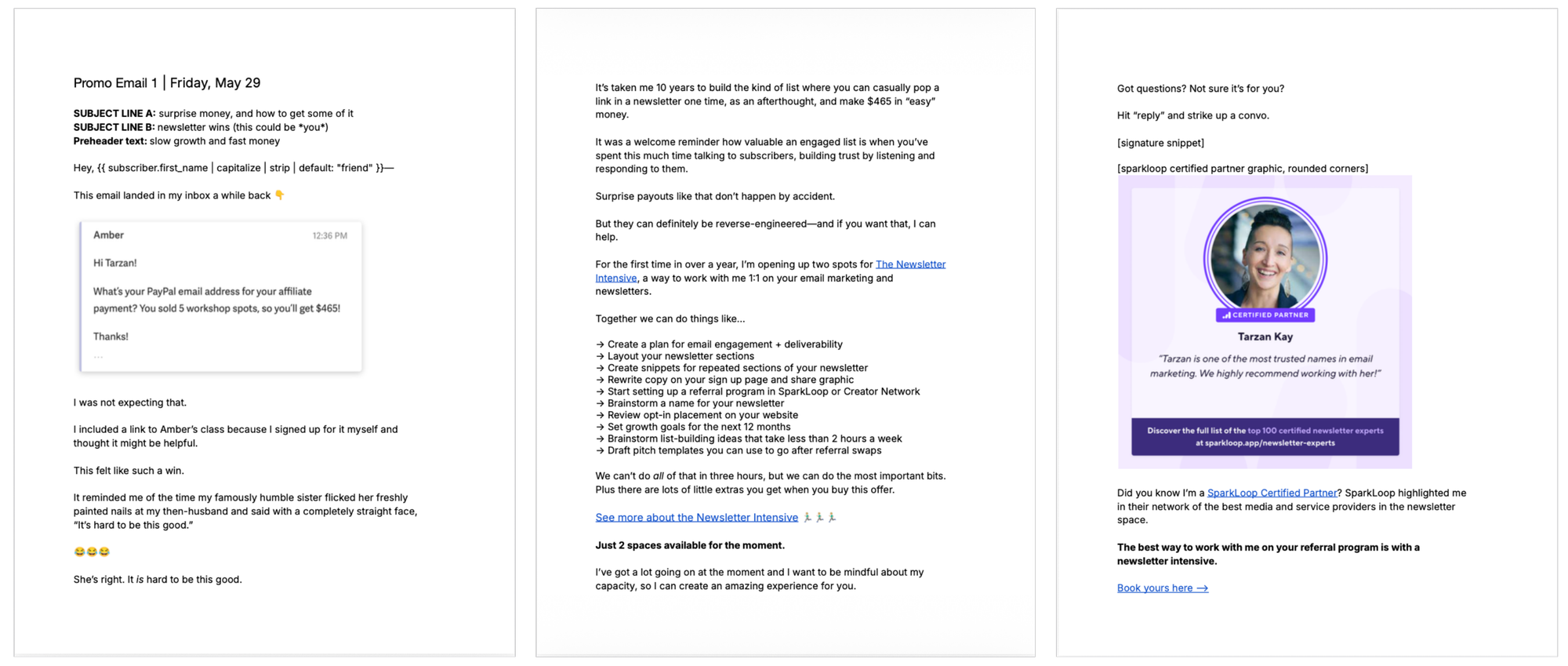
The first email worked the best, Tarzan said, and as you can see above, it opens with a specific detail like Nicole recommended. An unexpected affiliate payout because a link Tarzan casually dropped in another email got a sale. They then parlay that opener into a lesson about how having a strong list pays off in surprising ways and you can have this too if you join the Newsletter Intensive.
Tarzan told me she's run this kind of offer several times and the limited space messaging works, but only because she's built enough trust with her audience that they believe she's telling the truth about that. Real scarcity can help you sell. Fake scarcity can burn your goodwill.
Creating something so relevant you don't even have to send that many emails
Lib started a newsletter membership and when she launched it, she "sold out all 15 spots with the first 'now open' email." Now that's a pretty spectacular conversion rate from an email! But why did this work so well for Lib when many of us need to send multiple emails to get people into consideration mode?
Lib said, "It worked because I knew my list really well — I knew I was creating something very relevant to what they were looking for. Knowing who's on your list and creating offers that solve a problem they share is a winning combo."
The easier it is to say yes to your offer, the more people will say yes to it easier. I learned this when I launched Legends. After having to get on the phone to sell every membership spot in Growthtrackers, I sent one or two emails about Legends and saw several people join right away because the offer was better matched to what they wanted at the time.
Actually emailing people who took your quiz
Bev had a client named Chelsea who is a queer sex therapist and social worker. When they started working together, Chelsea had this quiz titled "Am I gay?" —honestly brilliant all around, no notes — but she hadn't added any kind of email followup to it so all the people taking it were just sitting on her list with nothing to do. Bev got to work adding an email automation and blocking low quality survey takers from the list.
Bev ended up removing 85% of the quiz takers from the list due to spammy email addresses, but she left the real ones and that paid off when Chelsea sent a newsletter to that segment and booked a paying client. Chelsea also said the automation has brought in paying clients too now who find the quiz late at night while questioning all their life choices.
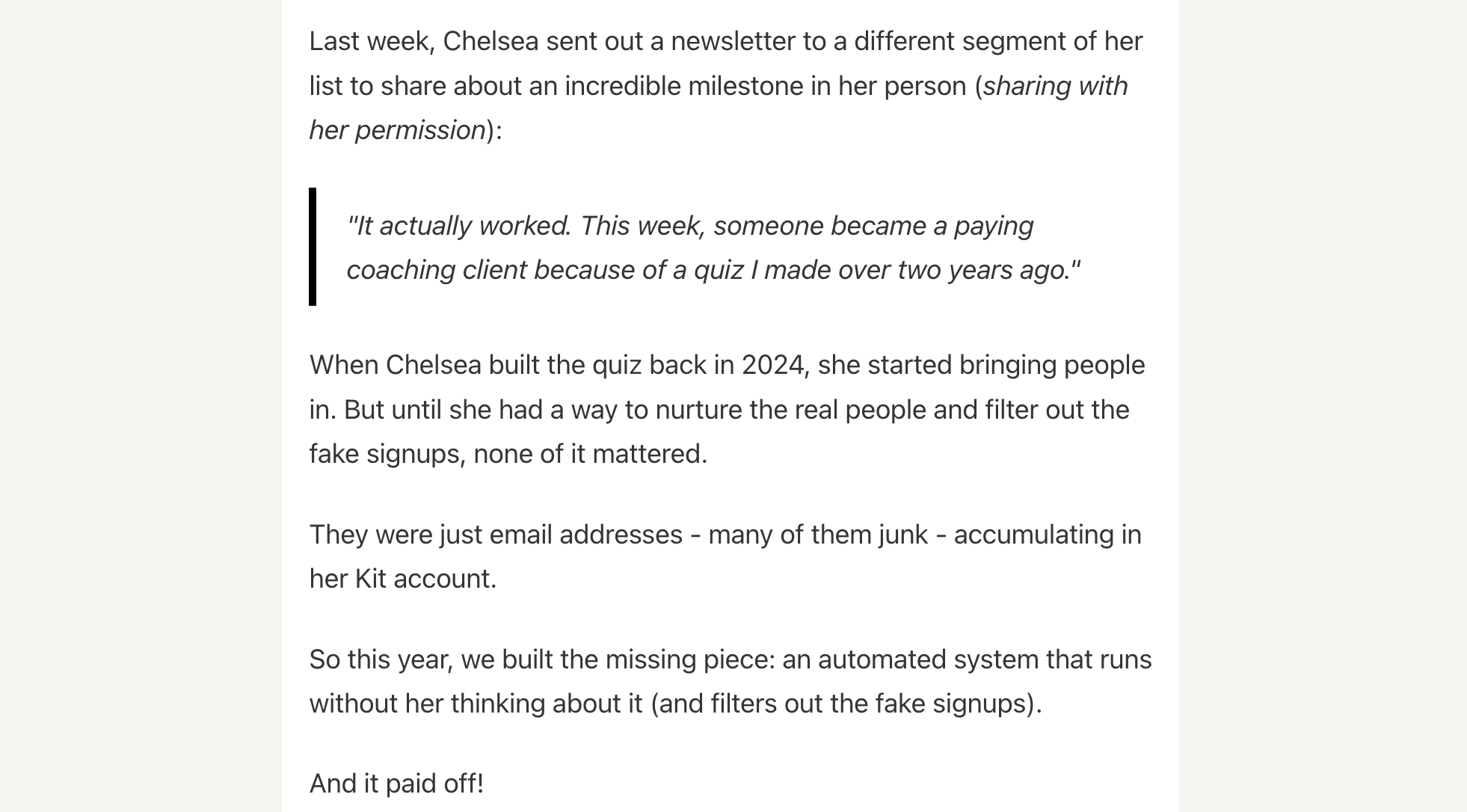
Bev told me a big part of why Chelsea's emails land is that she brings her personality into them. "She swears in real life so she swears in the emails and she's a straight shooter so she talks that way in her emails. Reading her emails is very much the way like she sounds in real life," Bev said.
This is also an example of how email automation can work for you while you're not at work. People take the quiz at all hours of the day when Chelsea's not on call, but they can move forward and become a client without her needing to take action, all thanks to a well timed email ask.
Using a timely topic to sell your solution
Nicole was offering a Conversion Messaging Map workshop but she made the hook and subject line "You don't need AI" to sell it. Super smart because AI is on everyone's mind and it makes what Nicole is doing more urgent, more applicable for her audience than just a regular ol' conversion workshop.
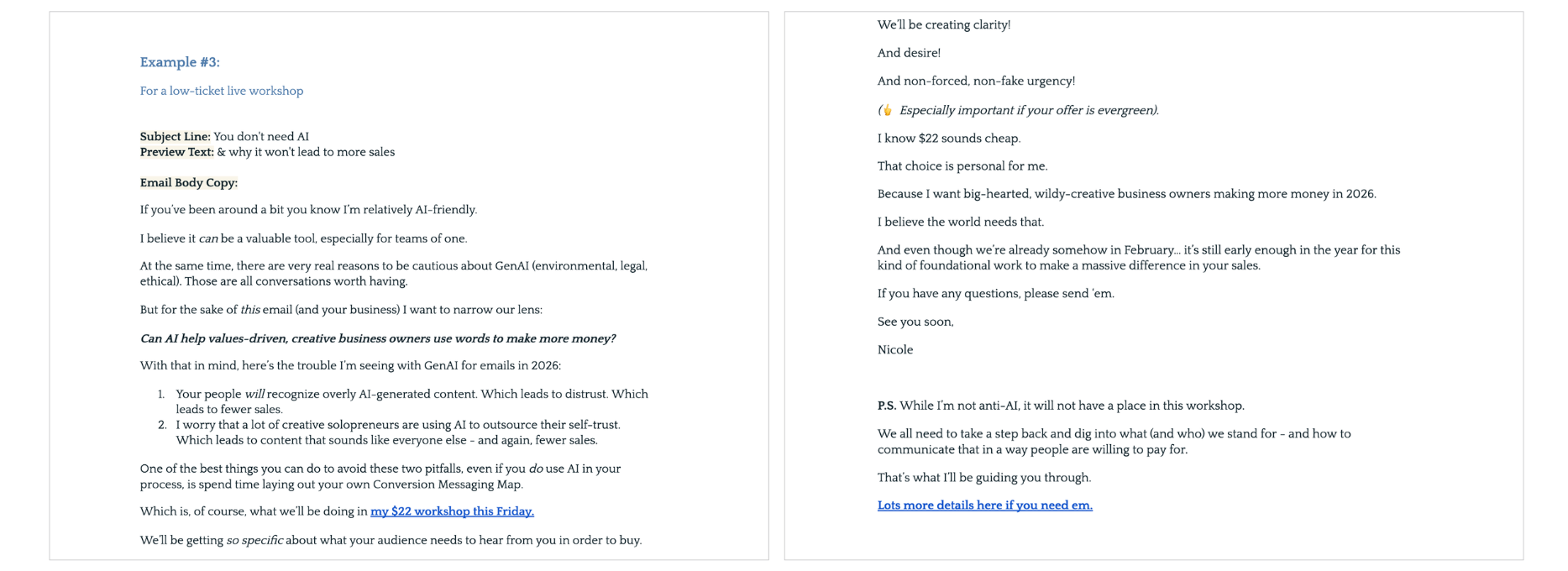
What's so smart about this email is that Nicole taps into the energy around AI to offer something that has nothing to do with it. She asks "Can AI help values-driven, creative business owners use words to make more money?" and then she lays out two problems business owners have with AI-generated emails. If you, as her audience, are feeling any inkling that those might be your problems, you've perked up here. Then, she shares the offer.
You'll also notice how concise this email is. Your sales emails don't have to be long. They just have to be persuasive.
Troubleshooting your own emails so they sell
You've gotten this far and you're still not sure why your emails aren't selling. I asked our experts how they would troubleshoot an email list that wasn't converting. Here's what they said to check.
Not enough subscribers or not the right subscribers: Back to step one, check that list quality and list size. If your list is 75 people and you're not even sure who they are, then "it's way too early to say that it didn't work yet," Tarzan said. Focus on list growth and specifically on list growth in places where your ideal clients might come from. (Hint: that might be through networking or 1:1 conversations)
Related story:
 Lex Roman
Not sending enough emails: Nearly every expert I spoke to said how much you send matters. Most of us are not sending enough emails. "Frequency matters. If you are doing a launch, seven emails, an email a day at the minimum," Nicole recommended. Outside of a promotion, you need to be regularly emailing your list. If you're not sure how often to send normal emails, Bev has a free newsletter cadence assessment to help you find your sending rhythm.
Too many CTAs: Emails that sell don't include a lot of links to other pages that aren't the transaction. "Every extra decision creates friction. So an email with a SINGLE, specific next step (reply, hit this link, book a call, etc.) converts better than one with a bunch of options," Lib said. Make sure your call to action is big and scannable. Buttons over links, always!
Too high barrier a CTA: Make sure your CTA is the right next step for your reader to take. "'Book a call' is one of the hardest calls to action you can use in an email, because it's such a big ask. Instead of going for that big conversion straight away, I recommend going for a micro-conversion first. For example, ask subscribers to reply with a certain word if they're interested, and then follow up with them one to one," Eman wrote me. She recommended testing different micro-conversions to see if you notice any change in uptake.
Not busting objections: Your reader will have hesitations that hold them back from buying. You can't just present an offer and not address those. "Anytime you make a promise, remember that your reader is going to have an objection to the promise. Your immediate next line should bust the objection," Nicole said.
Too generic a problem: Back to Nicole's recommendation about getting specific, it's way more effective to share your problem space through the lens of what your customers actually experience. "You need to talk to [your clients] and figure out what's keeping them up at night. What the problem looks like in their actual life. If they are struggling to sleep and you're a sleep coach, what is struggling to sleep doing to them?" Nicole said. Telling a story of one client's struggles, even if it's anonymized a bit, can land better than high level, Google-able problems.
Trying to help everyone at the same time: Your audience isn't a monolith. "A big one is the rule of one: one message per email, written for one type of person. You're not sending the same general email to everyone. If you have different audiences on your list who need different things, each of them should get emails written specifically for them," Eman told me. Even if you have a list that's all designers or all coaches, it's likely some of them are at different stages of their profession. The more you segment and target, the better your results will be.
A couple of the experts said they thought entrepreneurs are afraid to sell too hard and often weren't selling at all in their emails, which is definitely a thing, but for my crew, I think the problem is more about messaging. I read a lot of the emails my audience is sending their base and they're too damn generic. They read like something anyone else in their field could have written. If I was course correcting conversion, I'd start with Nicole's advice about writing more specifically about yourself and your clients and I'd try Eman's advice about micro-conversions first. Then, I'd work my way down the troubleshooting list to see what else I can finesse.
Your emails can sell for you or they can at least initiate sales for you. Our email experts have laid out the factors to consider testing from packaging your offer to writing specific stories to rightsizing your CTA, but ultimately you have to find your own voice for talking with your audience. The more you send emails, the more you can rev on the different factors at play, the more likely email will start to sell for you.
Which of the troubleshooting factors is your biggest opportunity? Share your thoughts in the comments!


