

How do I grow my newsletter?
This is the top question I get asked. It comes up in nearly every single event we do. I hear it in one-on-ones, in replies and in community threads. I feel like it's been covered 10,000 times on the internet but, if you're interested, I'm interested, so it's time to talk about it.
Everyone wants a silver bullet for audience growth, but after talking with many of you, I've learned that it's the low hum channels that repeatedly work bringing small batches of new subscribers slowly in the background that are most effective.
I specifically wanted to know how this community was growing their lists because a lot of the examples I see are "How I tripled my list to 1 million subscribers by chowing 100 tacos on a livestream" and that's not that useful for those of you who run small consultancies or who operate a membership. We are not just after subscribers, we are after buyers. We want high quality list growth with people who will do more than just open an email.
I talked to 9 people from our community, starting with the comments on this post and following up with a few who had strategies I rarely hear. These newsletter writers include a mix of media businesses, journalists, creators and service providers:
- Greg Nix writes the daily humor newsletter Chortle
- Femke van Schoonhoven writes about product design
- Sammy Bohannon writes about business operations
- Jon Woodroof writes about the cycling world in Twotone
- Stefanie Kruse writes about web design
- Théo Dezalay writes about video games in Téma Les Jeux
- Bryony Angell writes about birding
- Tommy Geoco writes about design tools
- Bryan M. Vance writes about food costs in Portland in Stumptown Savings
They each had totally different top methods for growing their lists. 13 techniques in total. One that I had never heard of. One that I was surprised worked so well.
More than what channel they're using, you're going to want to pay attention to why the channel is working for the person for whom it's working for. I did my best to spell that out for you but if it's not clear, write us a comment and let's get to the bottom of it. It's often the execution, not the tactic, that makes it so effective for email list growth.
Greg Nix writes the daily humor newsletter Chortle and grows his list with creator ads and submission calls
Creator ads
Greg buys ads with fellow creators who also write newsletters. To find ads, Greg searches Substack, beehiiv and Passionfroot. He also Googles around for newsletters that offer advertising using very generic searches like "newsletter + advertising."
"I'm narrowing down from there. Which of these are in my price range? Which of these have audience overlap? What's the availability?" Greg said. He writes a humor publication so it's ideal if he can buy ads in newsletters that are also funny, but he'll go broad sometimes just because there isn't enough supply.
He links the ads to a high performing post (rather than a generic newsletter signup) and he tailors which post he chooses to the audience of the newsletter where he's placing the ad. Greg says engagement is high from the people who make it through to his list and he sees some of them become paid subscribers of his publication.
Submission calls
Greg also grows his list through his calls for submission for freelance writing. It wasn't intentional, but it's something he's noticed. This was the only channel I heard that surprised me.
He opens submissions every couple months and he said he regularly gets 100-200 new subscribers out of it. Those freelance writers are joining his main list, but he's also started a separate list for them so he can email the calls out when he opens submissions.
Femke van Schoonhoven writes about product design and grows her list with YouTube videos
YouTube videos and freebies
Femke has a popping YouTube channel with nearly 100k subscribers that regularly gets 5-40k views per video. Not an easy feat in itself.
She told me she's posted a few videos that have brought her subscribers for years, including this one she made about how to create a UX research report which has driven thousands of subscribers. That video has 101k views as of this writing. The top line in the video description is a link to a freebie where recipients are subscribed to Femke's list.
Her winning recipe is this (in her own words):
- Make a YouTube video on a niche topic my audience is interested in
- Create and mention a free resource or template within the video, related to that topic
- Have the link take folks to a sign up form to get the free resource
- Utilize automations and workflows to send the resource while adding them to my mailing list
Before you write this strategy off as only for viral YouTubers, I want to share that I nailed this recipe precisely one time with a video on how to use Airtable to track leads. The video has 3k views and I've gotten 121 new subscribers from it via the template I included. The best thing about this strategy is that, as Femke pointed out, if you find an evergreen hot topic, it pays off for years.
Sammy Bohannon writes about business operations and grows her list with collaborations
Cross-promotions
Sammy realized most of her business was coming from referrals and personal connections so she started building her list that way too. Last year, she quit social media and leaned all the way into relationship building, joining The Co-Promotion Club (created by Legend Janna Carlson). Since then, Sammy's been honing her practice of cross-promotions through newsletter swaps, interview trades and co-hosted workshops. Here's an example of a promo trade she did with bookkeeper Aneisha Velazquez and another with marketing strategist Madeline Willett.
Sammy said, "I have to be careful about what collaborations I do. They have to be intentional and with either just one person or a small group of people, otherwise, I get a lot of people who are not aligned with my messaging."

To vet cross-promotion partners, Sammy digs into their business and personal social accounts to make sure partners are value-aligned. She'd rather spend more time making sure it's a good fit because she said her audience "only needs to grow by about 100 people a year. I can afford to be very selective in who I promote and who I trust to promote me."
Jon Woodroof writes about the cycling world in Twotone and grows his list with prominent links, meeting schedulers, and community features
Prominent links
This is an underappreciated and crazy simple strategy. Make your call to action link your newsletter everywhere.
Jon said they use twotoneams.link/newsletter as the main link on social media platforms or any profile that has a spot for a website. I do the same. If you're not doing this and email is a core channel for you, fix it now.
Meeting schedulers
When you book a meeting with Jon, after you've scheduled that meeting, you'll be redirected to the newsletter subscribe page. I've heard of people adding a checkbox in the scheduler itself, but I like the redirect as a more immersive experience. It keeps the journey going with your new friend so they can dive into more of your stuff. You're already top of mind in the moment—might as well keep them entertained!
Community features
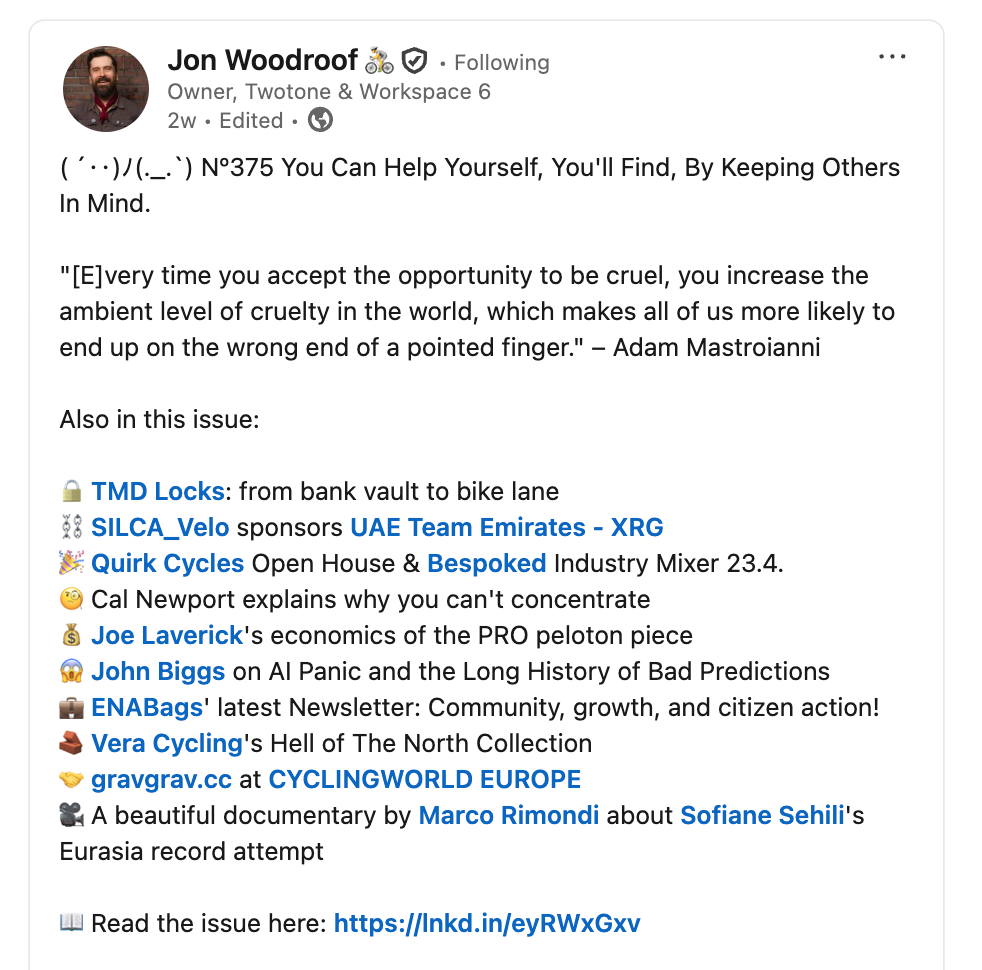
Jon runs a hybrid model with a creative agency and a media business serving the bike world. Unlike a lot of service providers, he takes a generous approach with sharing what's going on in the cycling scene, not just featuring their work but promoting all kinds of stories, events and news.
Jon said, "I offer to feature any project or event that I hear of in conversation in our scene, community or industry" as long as it doesn't interfere with Twotone's clients. As a result, Twotone has become a destination publication for cyclists which makes their audience reach much bigger than prospective clients (hence adding a paid subscription model too.)
How do these features turn into growth? Jon posts the newsletters on LinkedIn and Instagram and tags everyone featured so they interact and share.
Stefanie Kruse writes about web design and grows her list with guest webinars
Guest webinars
Stefanie offers to do webinars in communities and memberships about web design. During those sessions, she shares a free resource that matches the topic to grow her list. She said this results in the "most engaged and long-term readers, because they know me personally."
To find these groups, Stefanie started with ones she's already active in. Then, she asked those community leaders and other members what other groups they recommend. She tracks community contacts in a CRM (which she's thinking about selling by the way) and reaches out with a simple pitch via LinkedIn DM or email.
She gave credit to Tad Hargrave and Lilli Graf of IMMA Collective who both inspired and shaped this strategy. I've been seeing a lot of people in our community using this technique, which can also directly pay off in clients.
Théo Dezalay writes about video games in Téma Les Jeux and grew his list with reader referrals
Reader referrals
Théo made a direct appeal to his readers to share his newsletter back in March with the goal of attracting 300 new readers. That's three times his normal monthly growth. He smashed his goal in 3 days.
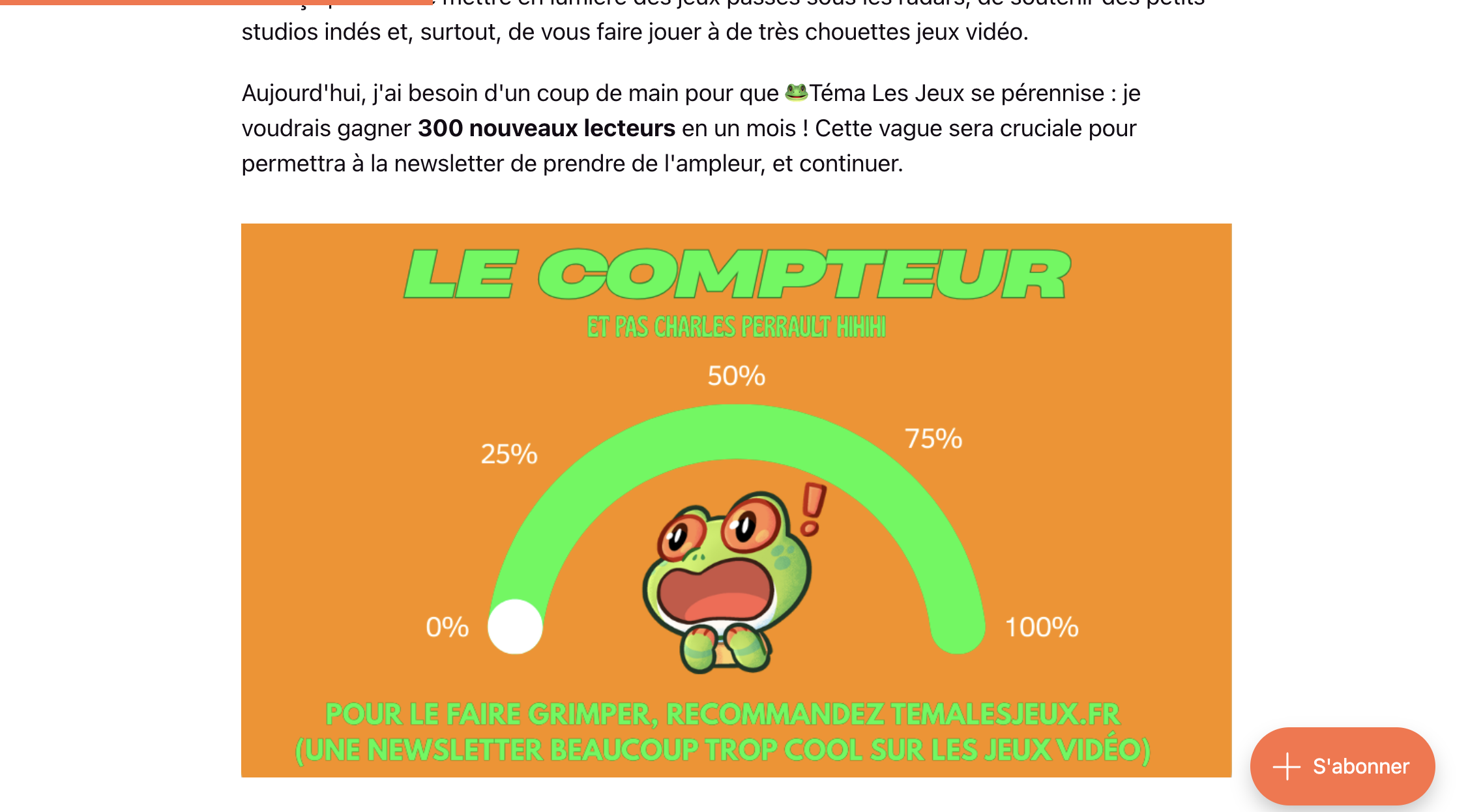
Théo sent one dedicated newsletter edition about sharing his work. In it, he listed three ways readers could help spread the word: forward a recent newsletter, share a story on social media or ask a friend to sign up for the newsletter directly. He also included the above hilarious graphic of his brand frog along with a goal tracker (he later adjusted the colors to make them higher contrast thanks to reader feedback.) His fans came through in force referring 302 new readers onto Théo's list and 5 of the new folks immediately became paid subscribers too.
This reader referral campaign was inspired by a story I did on a similar strategy Lyneka at Prison Journalism Project used to grow their list. Setting a clear goal and sending singular messages about it (not buried in a newsletter with other calls to action) is how you get this to work!
Bryony Angell writes about birding and grows her list with bylines and speaking
Bylines
Bryony is a writer and a birder and, when she publishes new stories, she makes sure that all roads lead back to her website where new fans can join her personal mailing list.
I first heard about this strategy from now independent film critic Ty Burr who frequently writes for the Washington Post and told me his bio there drives the most signups for his list. If you're writing elsewhere, make sure your newsletter page is in your bio.
Speaking
Bryony also gives a lot of talks like this event with Birds Connect Seattle. She'll pass around a physical piece of paper to sign up for her list at events and she gives several verbal calls to action to do so.
She knows her all ages audience might be overwhelmed by only having an electronic sign up, hence using the clipboard method. "This granular, analog method works for me as I speak to very small audiences of people who are slower to adapt to technological advances," Bryony said.
Tommy Geoco writes about design tools and grows his list with Manychat
Manychat for Instagram
Tommy is a social media whiz, having mastered TikTok, YouTube, LinkedIn, Twitter, and Instagram with over 100k followers on nearly all platforms. But we all know that social growth doesn't always equal newsletter growth. To keep his newsletter growing, Tommy started using automation tool Manychat, which works with TikTok and Instagram, to turn followers into subscribers.
Any time someone follows Tommy's account on Instagram, they'll get an automated message inviting them to join his newsletter. But Tommy doesn't just include the link. He explains why they might want to join. If they say "Yes, I want in," then Manychat sends a follow-up message to get the email address. Tommy's got Manychat hooked up to his beehiiv account through Zapier.
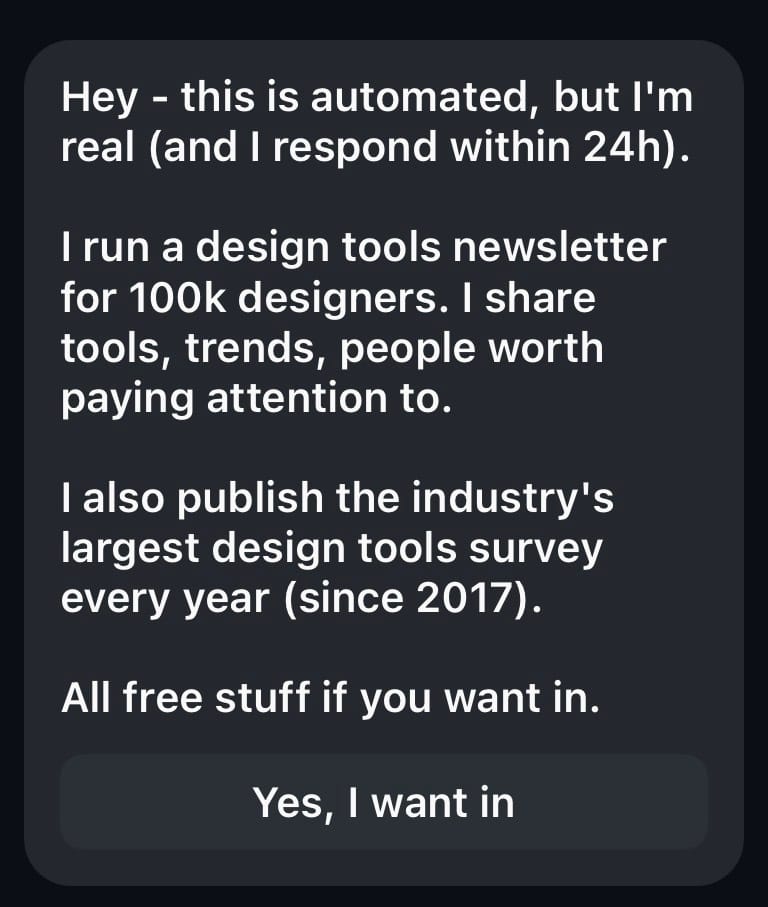
This method does not require that you go as viral as Tommy regularly does. If you're using Instagram or TikTok, you can use Manychat to encourage more of those followers to join your list.
Bryan M. Vance writes about food costs in Portland in Stumptown Savings and grows his list with earned media
Earned media (mentions in the press)
Bryan's newsletter has been featured in 99 Percent Invisible, Bloomberg, and in lots of local Portland press thanks to a mix of smart social posting and relationship building with reporters.
The 99PI and Bloomberg mentions came about because Bryan says he was openly posting about his challenges growing a newsletter business on social media. It's worth noting that Bryan has a media background and therefore a lot of his followers and online connections are from the media space and are more likely to see his posts when sourcing their own stories.
For local press, Bryan pitches himself and builds relationships with local reporters. "Landing on the radar of local reporters/outlets and becoming a source for them when personal finance issues are on their table. Basically, talking about myself and my work openly and often seems to work in terms of keeping me on people's radar," he said.
Bryan noted that these press plugs are pretty rare, but when they happen, they result in a big boost of newsletter growth. I can attest to this because I once got a newsletter mention in the LA Times that brought me 1000+ new subscribers in a single day.
These newsletter writers prove that there's no one way to grow your list. You've got to try different channels and methods and pay attention to what works for you. Both in terms of what brings you quality subscribers and in terms of what feels easy for you to keep doing. Experiment with the methods above or any channel you find compelling and follow through to track how those new subscribers behave on your list. Keep the channels that bring in right fit folks. Ditch the ones that don't.
My favorite thing about the tactics our friends shared with us above is that none of them are gimmicky. They are evergreen strategies that can be repeatedly used. One time growth hacks are fun to try but, for most of us, it's these low hum channels that bring in small batches of newsletter subscribers regularly that are going to actually help us build a healthy list.
Don't be fooled by the vanity metric of list size. Unless you are monetizing your list size, it does not matter. What matters is that you find people who are interested in what you're sharing and who want to pay you, support you or amplify you.
Do any of these methods resonate with you? Tell us how you're growing your list in the comments!
P.S. We ran a live session in January on what works to grow your newsletter that 42 people joined us and shared their experiences with different channels. You can grab that recording and recap for $10.


