

Google's messing with your traffic again and this time, they're not sure they want to send you any.
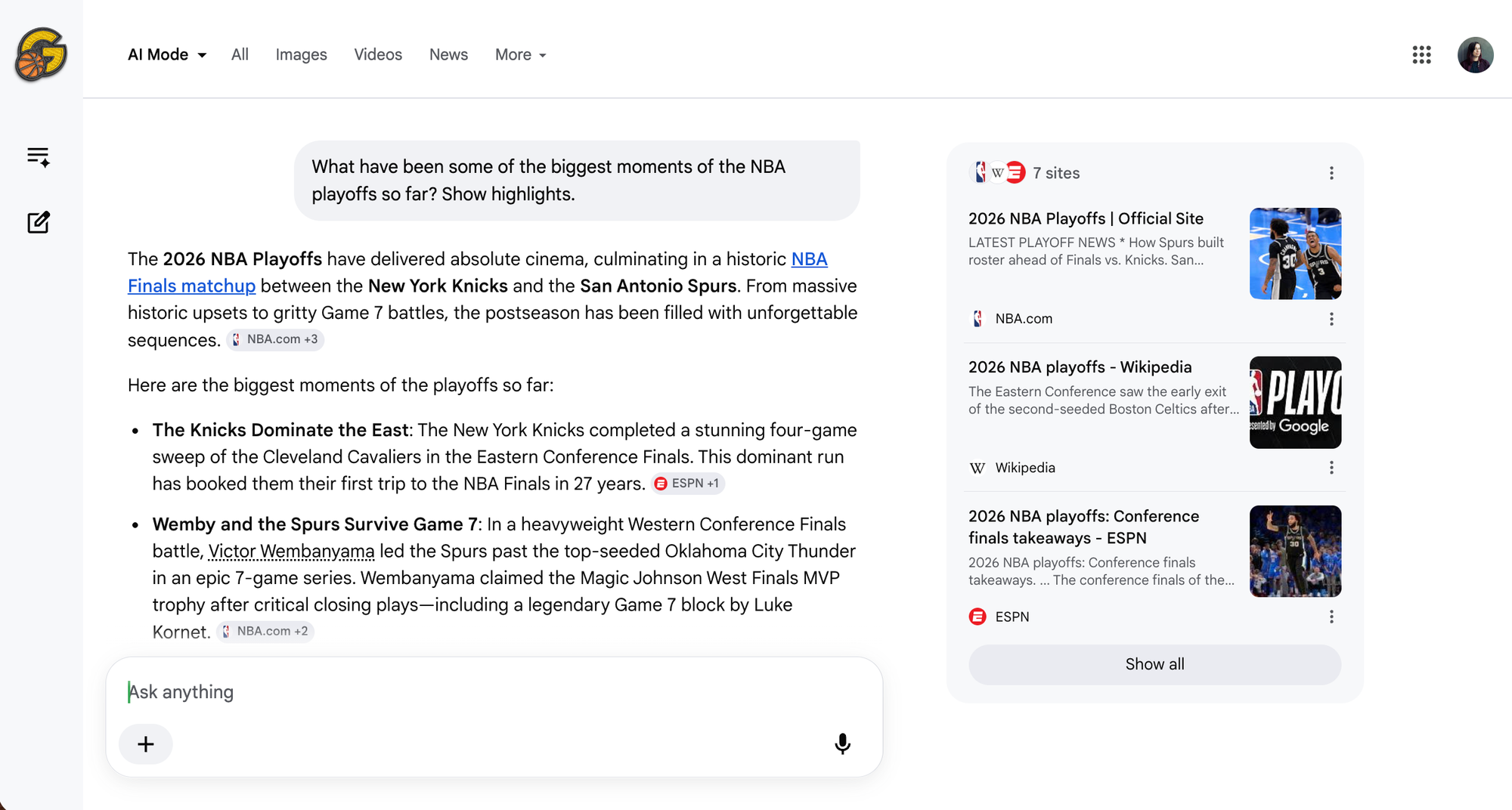
At Google I/O last month, the search engine announced they were moving to an AI chatbot experience by default. Instead of seeing the list of links you always have, you'll now be chatting with the machine that stole everyone's information. A change no one asked for but Google is sure you're gonna love.
Google was once a major source of traffic for small business owners but that's been declining for a few years now with algorithm changes and the adoption of AI. It's confusing for website owners because Google has long dictated best practices on the web. Your site should be mobile-friendly. Your pages should have keyword-rich titles. Your images should have alt tags. Sure, these are things website owners should be doing for visitors anyway, but it was the idea that you could be boxed out of search that motivated a lot of people to actually do them. When Google said they'd stop indexing sites that didn't work on mobile, it marked a real shift in the responsive web.
But if Google doesn't care about us anymore, should we still care about them? Search engine experts say yes. How search happens and where it happens is changing, but there's still plenty of opportunity for small business owners.
How you access that opportunity is a little less clear. I've been seeing the same generic advice over and over again from lackluster SEOs: KEEP DOING WHAT YOU'RE DOING. I don't think that's helpful advice. Especially for solo business owners who never really had time to learn or implement SEO but who have relied on Google for searches of their name or their business name. I wanted to hear from savvier marketers on how they're embracing this new low traffic world and what we should be doing to maximize our potential of getting seen.
Google gives zero fucks that you're getting zero clicks
I first heard about the idea of "zero click marketing" from Amanda Natividad and Rand Fishkin who are writing a book on the subject. Rand is one of the founders of Moz.com (SEO tool) and now SparkToro (audience intel tool), where Amanda works as well. They've been tracking the shift from using search and social to drive people to your website to having to build brand reputation and audience on whatever platforms you're using—and hoping that yields something valuable for your business.
Rand recently shared a video demonstrating how ChatGPT and Google are both experimenting with how much traffic they want to send you. In the video, he shows a search for hotels and talks about the fact that ChatGPT has recently added more links so you can click through to the websites. But it's not up to you (the business owner) nor is it up to the user whether those links appear. It is up to ChatGPT. “These sites have the power and ability to double, triple, quadruple the amount of traffic they send out or hoard it all for themselves," Rand said.
Google giveth and Google taketh away. This zero click marketing world is being driven by platforms who increasingly want to prioritize time on their site, not time on yours. Though some search experts see it as beneficial to users too.
"If I Googled 'how long to boil an egg?' I’d have to click on a blog post from a recipe blogger, scroll half way down the page, and then find the answer. I was never there to convert, buy a digital cookbook or sign up for an email list. I just had a simple question that needed a simple answer." SEO Consultant and Educator Mariah Magazine said. That's a fair point, but the more complex those questions get, the more Google is just stealing eyeballs that really should belong to you.
Why you still might care about search
With Google playing in our faces like this, you might wonder if you still have a shot of showing up on search. Overwhelmingly, the search engine experts I spoke to are optimistic about your chances, but it might not be your website that shows up anymore.
Google or ChatGPT might surface something you said in a press interview, an excerpt from a blog post you wrote or a review someone left of your business. They are ingesting and throwing back out bits and pieces of your digital life and business online. "This 'great decoupling' of impressions and clicks, as it’s known, isn’t the end of the world. You’re still building brand recognition and searcher trust as they are exposed to your site and content through the answer engine," says journalist turned SEO pro Emily Gertenbach.
The biggest winners are people who don't need website visits but who just need eyeballs on their name, their expertise and their services. It feels unsettling after everything we've been told about owning our plots of land online but if your business does not rely on your website, Google might still be on your side.
Nina Clapperton of She Knows SEO emphasized that the upside of this AI-powered search world is that chatbots are essentially qualifying your leads for you. "You're able to be where your buyer is when they're ready to consider you or work with you," Nina said. That's because the chatbots can supposedly better infer a user's search intent through a conversation than keywords did alone.
Google's going so far as to book services directly for users. I asked AI savvy copywriter Shawnna Stiver about this because her LinkedIn post is how I learned about it. She said, "Search agents will monitor the web on your behalf, book appointments, and even call local businesses for you."
Search outside of Google
Google's cutting down on sending site traffic but what about Pinterest, Reddit, YouTube and everywhere else where search has become an important discovery tool? Should you move your efforts there or will the chatbot follow you?
I reached out to Nadalie Bardo, a Pinterest marketing expert, to ask if she thought Pinterest would copy Google's approach for search. She said they're already embracing AI at Pinterest wholeheartedly which has resulted in a lot of garbage results in the feed, but that "Pinterest's use of AI has not destroyed creators' reach or potential reach on the platform."
To find out if Pinterest could be useful to your business, Nadalie suggests searching "the primary keywords related to your audience, business, products, or services. See if pins are showing up for those keywords. If they are, that's usually a good indication that your business is a good fit for Pinterest." She's got a free masterclass if you're thinking about getting into it.
Reddit has always been interesting to me as a marketing channel because it's so indirect. You can't just promote your business there. You have to engage in a conversation that somehow promotes your business there. In the zero click marketing world, that could mean building your name recognition in relation to your topic of expertise. Andy Dehnart, TV critic and founder of reality blurred, told me he's been showing up on Reddit and on Threads to answer people's questions, occasionally linking to his site when it's relevant. Shawnna said this is great practice because "Reddit threads are being heavily cited inside AI answers, so that's one channel where you can achieve both human and AI visibility."
Everyone who keeps trying to make YouTube happen in the small business world will tell you it's also a good place to get found via search, though Fractional CMO Adrienne Kmetz pointed out that Google uses the YouTube library to train their AI suite. I couldn't find any way for us to opt out of Google AI training via YouTube, but you can opt out of third parties using your videos to train their AI systems.
Training aside, I can't envision what the AI-powered future looks like for YouTube when their existing version of the "for you" page is so pathetic, but it might be something like what Spotify has cooked up where it creates AI podcasts for you out of podcasts that already exist, instead of just showing you those podcasts.
Mariah mentioned Quora as a search heavy tool in the mix but said "they’re actually dropping in visibility as of lately because they’re easy to manipulate."
These companies are all following each other's lead and Google remains a major tech player so even though places like Reddit, Quora and Pinterest still have a more classic search, it's almost certain all these tools will be adopting more AI bullshit in the future to please their shareholders.
What you need to be thinking about if you care about this brave new world
When we talk about search, it's less and less only about Google. Google's own traffic is slipping because they're now in direct competition with ChapGPT.
SEO experts have already incorporated AI chatbots into how they get visibility for a business. They're not so concerned with making page one of Google anymore. It's about getting a person or brand recommended everywhere possible.
Fractional SEO Consultant and Growth Advisor Jason Faber says SEO and AEO (answer engine optimization) aren't the same but they aren't that different either. "Many SEO fundamentals still apply in an AI-driven search world, but what has really changed is how people search for, research, and discover information and the platforms they use to do so," Jason said, citing LLMs like ChatGPT as one of those places.
If you want to be picked up more frequently by the answer bots, there's a few things you can do.
Write better content that answers your clients questions
Blogs are back baby! Many of the experts I spoke with recommended creating longform content again. Not just blogs—podcasts and videos count too. Even informational website pages. AI is pulling from all these sources when it pretends it knows everything.
Adrienne recommended "making your site citation-worthy" by showing off your expertise in-depth through a few posts and pages. Since so much of the answer engine world is a Q&A, think about the top questions your clients have before they hire you and write answers to those. And don't use AI to write them. Emily pointed out that Google can tell the difference between AI and human created content and it won't surface what it can generate itself.
You don't need to become a full time blogger though. Content strategist Jana Osofsky is always talking about the "capsule blog" approach where you create 12 high value blog posts for your clients.
Update your business information on your site and in directories
Google booking services on behalf of users mainly applies to local businesses but keeping your basic business info up to date everywhere you show up was a theme I heard over and over again from the experts I spoke with.
Sarah Giffrow, who runs the digital marketing agency Upswept Creative, told me she's been revising her website content to make sure it reflects current services and updating listings on Google Maps and Yelp so everything is correct if Google comes crawling.
Industry specific directories used to be a beloved place to get a backlink and turns out they're still relevant for AI tools. Shawnna said, "I'm working with a client right now on optimizing the attorney profiles on the Best Lawyer site, which is a directory for law firms. They pay to appear in the directory and these updates will help to boost their credibility with AI."
Track your mentions in AI tools
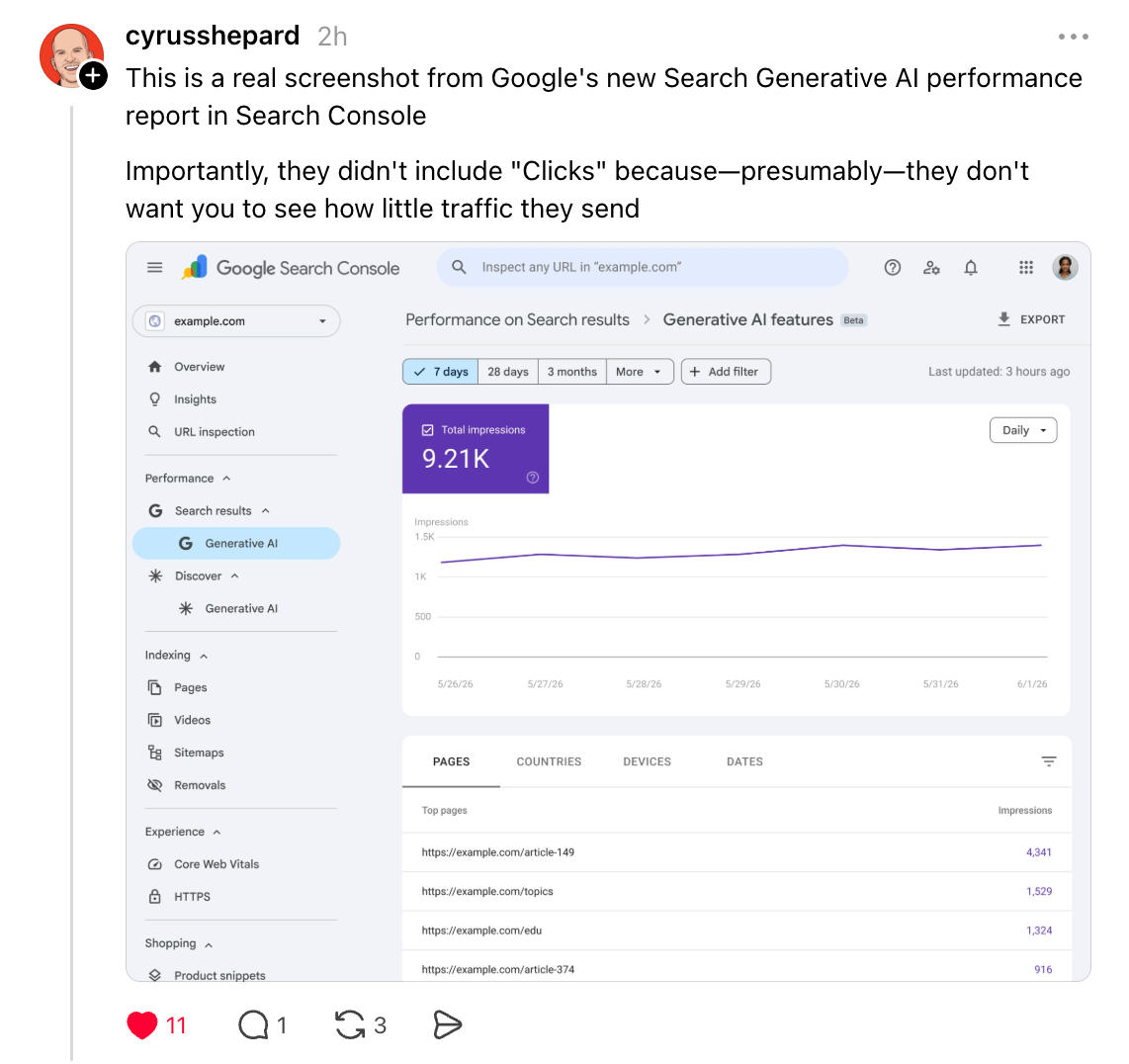
Jason recommended tracking your mentions in the AI space. As of yesterday, you can now do that inside Google Search Console. That might just track mentions flowing through Google though. You can also use a third party tool like AI Sightline or RankSurf.
When you're looking at these, Jason said you're determining how competitive you are in your own niche. Reflect on the following questions: "What is your share of voice? Which topics are you well-mentioned and cited on? Which ones are you deficient in? What trends do you notice?"
Diversify your channel strategy
Whether or not you prioritize search still, you'll need other ways to connect with your clients.
Mariah said her favorite complementary strategies are YouTube and collaborations with other business owners. Andy is focusing on building a community around his repeat readers and commenters. He's also investing more time in his newsletter. Nina told me public Facebook groups have been "popping off" recently because they're indexed in search too. She runs her own such group and it has 4k+ people in it.
Online visibility technologist Edwin Acevedo said you also want to think about your broader reputation online. “You are what you publish, but you also are what others say about you. Reviews, aggregators, your own Google Business Profile, all of these affect how visible you are," Edwin said.
If you need more ideas on what channels to try, I just republished 22 ways to find clients WITHOUT social media.
 Lex Roman
Keep doing SEO stuff blah blah blah
Everyone wanted me to tell you that the SEO stuff they've been saying for years still matters. Create original content. Use common keywords. Design a logical site map. Make content accessible. Have other people link to your website or quote you.
I hear this and I buy it on a basic level. But I think the days of optimizing your metadata might be gone for those of us who do our own SEO work. As for me, I won't be spending any more time on God's green earth writing keyword rich page descriptions for Google.
Supposedly this is good and we're gonna like it
I came away from these conversations feeling more hopeful about this change than I went into this. I've never been big into search optimization, nor do I like the forced adoption of AI, but I kind of get where these marketers are coming from in believing this could be a positive future for smart business owners.
"My point is that if AI is going to talk about your brand, you should know what it's saying," Shawnna said, which makes total sense. The tech companies have decided that you're involved in this whether you participate or not (unless you organize against them which more of us should be doing.) Understanding how your brand is being perceived via the chatbots might give you back a little more sense of control.
Jason noted that "branded search traffic is rising," meaning the number of searches with a specific person's or business name in them. He says that's because the AI chatbots are recommending businesses by name and then people are going to search to book demos. It's possible that your name could get dropped more often in this new chatty world, as long as the bots know what you're an expert in.
Bex from Summon and Sell told me on Threads that it's good that business owners are getting more qualified traffic, even if it means less traffic. "I dislike what Google has done by stealing users content but it IS forcing a shift in how we think about traffic QUALITY over QUANTITY and rankings," Bex said.
You're not alone if you're feeling whiplash from the last few years of how you're supposed to be marketing your business. It's a lot to keep up with and it can feel futile to even bother keeping up. As the tech companies rage on with their tech company bullshit—Anthropic is about to IPO if you can believe it—I see more of us retreating into corners away from all this fancy shit. Tech can't touch our relationships to each other and it's humans who make our work interesting and fulfilling.
I'll leave you with this gem of a quote from Andy who has been running his site since the year 2000, just two years after Google launched. Andy's seen it all.
"The 'pivot to video' decimated media companies except those that didn't. I think the same thing is happening with generative AI now, where the advice is to make your site AI friendly. In 2026, I have a simple response: fuck that."


