
You don't need to loudly announce your departure. You can just leave.
When the millennial exodus from Facebook began a decade ago, it became common practice to make a holier than thou post about why you were leaving. This quickly turned into a joke that you didn't need to make it a whole thing. You could just bail. No one really cares. There are billions more where you came from, after all.
The dominant reason people left at that time was "mental health." The feed became too addictive, too depressing, or too harmful on a personal level. Some also pointed to privacy concerns due to the Cambridge Analytica scandal of 2018 which was, to my knowledge, the first major outing of how easily social media could be weaponized against its users.
People are always leaving social, talking about leaving social or complaining about how they can't leave social, but when I noticed a flurry of entrepreneurs posting about their plans to exit social in 2026, I wondered if this moment was different from before.
I started talking to entrepreneurs who had left or were thinking about leaving to find out. What I learned made me question why I wasn't joining them in nuking my own accounts.
It's not just about mental health anymore.
The reasons people, and more specifically business owners, are abandoning social media now include rampant AI-powered thieves, deep fakes and copyright infringement. Privacy and surveillance concerns have escalated from "this app might collect data I don't want them to have" to "the Secret Service might show up at my house" because of a TikTok or a tweet.
The dangers are much more apparent and the benefits are waning. But for entrepreneurs, creators and founders, social media has been in the portfolio of core marketing channels since its invention. It's not like you're ditching your high school friends on Facebook and learning how to make phone calls again. When you deliberately cut off chunks of the audience building that fuels your income, you have to replace them with something else.
So, how replaceable is social media for business and what are entrepreneurs replacing it with?
Why leave social media now
Author and indie techmaker Brian David Hall was inspired to close his social media accounts when his wife traded her tech job for a ceramics endeavor.
"I saw the lightness that came into her when she deleted her LinkedIn account. And I thought, 'I want that,'" he said.
So Brian shut down his LinkedIn, then his TikTok. "I was kind of on a roll at that point and the thing I found is, with every step away from that posting every day, scrolling everyday lifestyle, I just felt better. I keep asking, 'when does the point of diminishing returns come?' And it never came."
He's now fully off social, with the notable exception of Mastodon which—since it's a decentralized nonprofit—feels different to him. More like a developer community of the early 2000s as evidenced by the fact that he donates cash to keep the server his account is hosted on running every month.
Is it a luxury to be able to leave social without repercussions or can we all make that leap into the light? Brian himself pointed out that he's already built a strong network that trusts him and that if he was earlier in his career or in his business, he might not have scaled back his online presence so much.
Along those lines, Dr. Amelia Hruby called being offline a "status symbol" in a recent 2026 marketing predictions podcast. Amelia's body of work heavily centers on how you can reject the attention economy and become more present in your life and work. She's been off social a couple years now and tapped into the social media free movement so I asked her why it seems like more people are quitting now. She laid out some of the defining characteristics of the 2025 social media scene:
"Meta removing fact checking, TikTok potentially being banned, the rise of AI slop, and increased enshittification across all platforms [have made people lose trust.] Even though plenty of people had been sounding the alarm for years (myself included), those changes made it blatantly obvious that social media is no longer a safe or feel-good space."
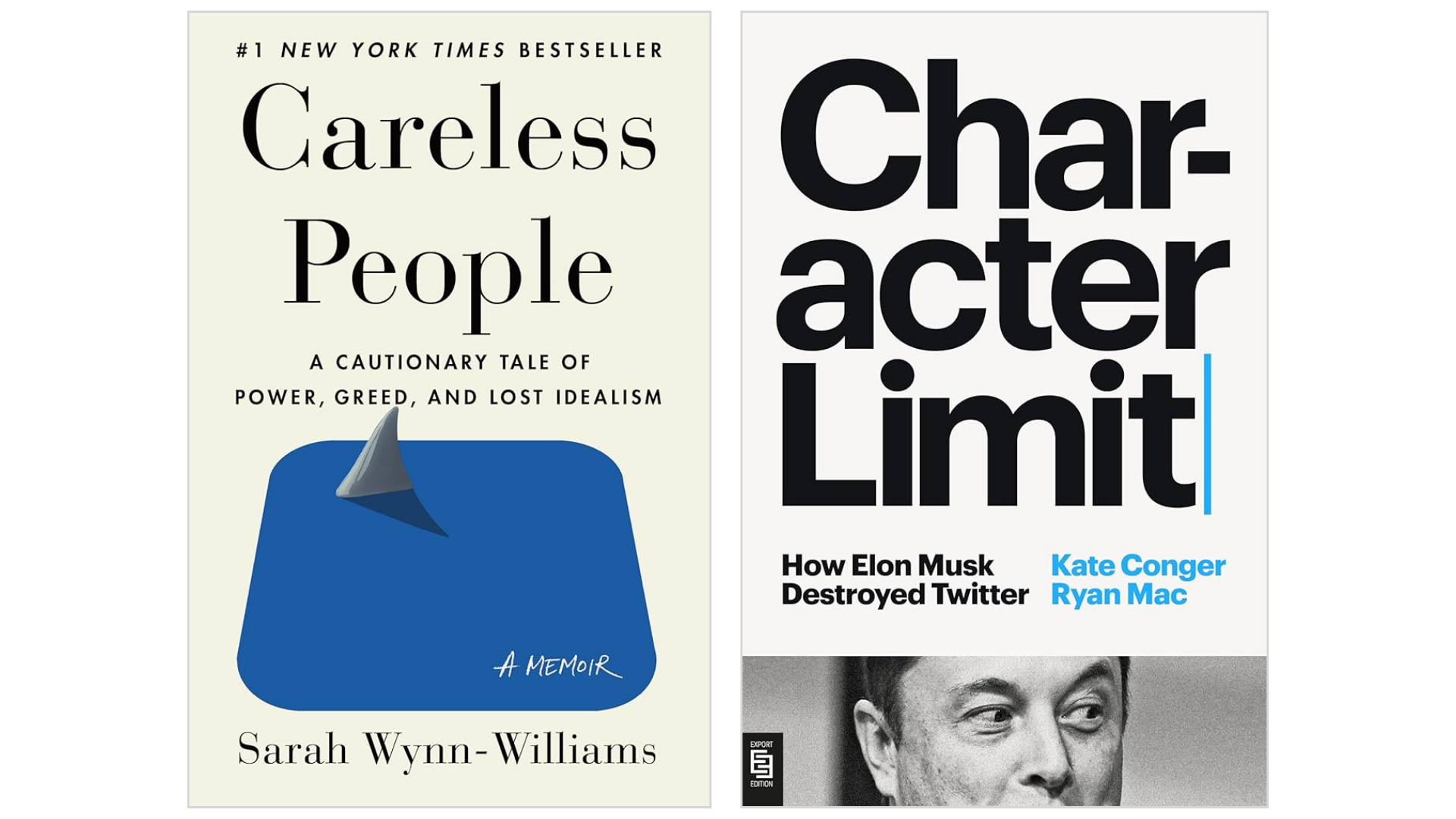
From what I've experienced myself working in Silicon Valley, the most prominent founders of social networks—Zuckerberg, Dorsey, Spiegel, Systrom and Hoffman—had no clue themselves where this was all heading when they started Facebook, Twitter, Snapchat, Instagram and LinkedIn. But now, we're 20 years in and their pattern of opportunity has become darkly predictable. Build a userbase and sell them off to the highest bidder, whether that's using your treasure trove of data for political control, packaging it as a toy for bored billionaires or just making a killing off advertising. If you haven't read Careless People or Character Limit, you'll never look at mindlessly scrolling the feed the same way again. You'll also see why I have the same concern about where Substack is headed.
Beyond these mental and moral quandaries that social networks present us with, many business owners are noticing their social channels actually aren't doing as much for their business as they previously thought.
Seth Werkheiser, who founded Social Media Escape Club which serves musicians, artists and other creatives, said "Instagram isn't doing what it used to do back in the day" which means that "Artists are having to chase whatever appeases the algorithm more so than focus on the art that they make."
This is a near constant complaint from people with bigger followings who have taken notice that their posts are getting less reach than they once did. Online marketing agency owner Sarah Giffrow told me, "An average organic post gets shown to maybe 2-6% of your audience. It takes a lot of effort and time to start seeing results."
What was once bad for your mental health is still bad for your mental health and is also now bad for your privacy, bad for your physical safety and bad for your return on time invested. Not a lot of reasons to stick around when you see it like that.
Where to find your audience WITHOUT social media
My main question for those I spoke to was about what channels they were using in lieu of social. Even if you aren't seeing a return on your time posting and boasting with the rest of us, social media activity still counts as marketing visibility, and more importantly, as visibility in front of your existing network.
How are these entrepreneurs reaching their audience?
Email newsletters and earned media
Email newsletters reigned supreme as the top replacement for social media among the people I asked. Seth recommends this strategy to his community at Social Media Escape Club and shared some of the creative ways musicians are replacing online audience building.
Musicians passing around clipboards to grow mailing lists at their shows was a popular strategy but some artists are thinking bigger, like The Cadillac Three. When they went on tour in 2023, they built a custom photo booth using an iPad that required email to receive the photos, yielding over 5,000 emails for their list at a cost per new sub at $1.67 or less.
Others turned to local—now underutilized—news channels to get the word out. "An artist on one of my weekly calls, Jes, was going to play this small town that she'd never played before. Rather than post about it on Instagram, they got in touch with the local newspaper and the college radio person. They had 150 people at their show that night in a town they've never played before," Seth said.
In-person networking and guest talks
Lindsay Hyatt, a copywriter and brand strategist out of upstate New York, is focusing on offline events and network building. Lindsay was one of the first people I noticed declaring a public departure from social this year. She recorded an episode of her podcast back in November about her plan to swap Instagram and Threads for showing up more around her city.
Regarding her local strategy, Lindsay said, "I try to see and be seen—even if it's just at the coolest new coffee shop downtown. I write for our local magazine, so even that I count as staying front of mind. I'm not shy about telling people I'd love to catch up in person." Lindsay's been experimenting with in-person meetups for the last 5 years as an entrepreneur, and before that, she held corporate roles in the same region, which is how she built the foundation of her network. She's become so passionate about this local approach that she's about to launch guides on how to market offline.
London-based Brett Freeman, also a copywriter, is on the same wavelength. Brett's core audience is fitness professionals and many of them operate local fitness industry groups in his area. He offers guest talks for these communities to get his work out there, building his network and his email list at the same time with enticing free resources attendees can download. Brett told me that his clients have shown a lot of interest in moving off social too, so he's created a whole newsletter on his experiments in being "unsocial" and he plans to start making it a bigger part of his brand this year.
I even learned showing up at offices in person to pitch services and partnerships could work. I was in a session inside The Playhouse community when business coach Maria Medina shared (and gave me permission to repeat here) that she went door to door to businesses in Orange County, California. She found a coworking space she was able to collaborate with by tabling there with some of her printed materials, which yielded a couple paying clients.
Podcast guesting and hosting
One of the most novel replacements I heard was from Brian David Hall who is planning to market his next book on finding clients with a podcast guest tour.
Doing guest interviews on podcasts is far from unheard of, but as a primary strategy, it surprised me, mainly because you're relying on other people's promotion ability and their audience quality rather than your own. But Brian is not going for volume. He's after a few deep, authentic connections. He doesn't have an email list. Instead, he wants people to send him a personal email after hearing the episodes.
"If I go on 20 podcasts and get 3 emails, that's actually success for me. That's enough, because I want to be so selective. I really want to meet people that I vibe with. It feels higher stakes in 2026, than it did in 2021. In 2021, we were all gonna live in the future and make the world a better place. Now, I want to know your politics," he told me.
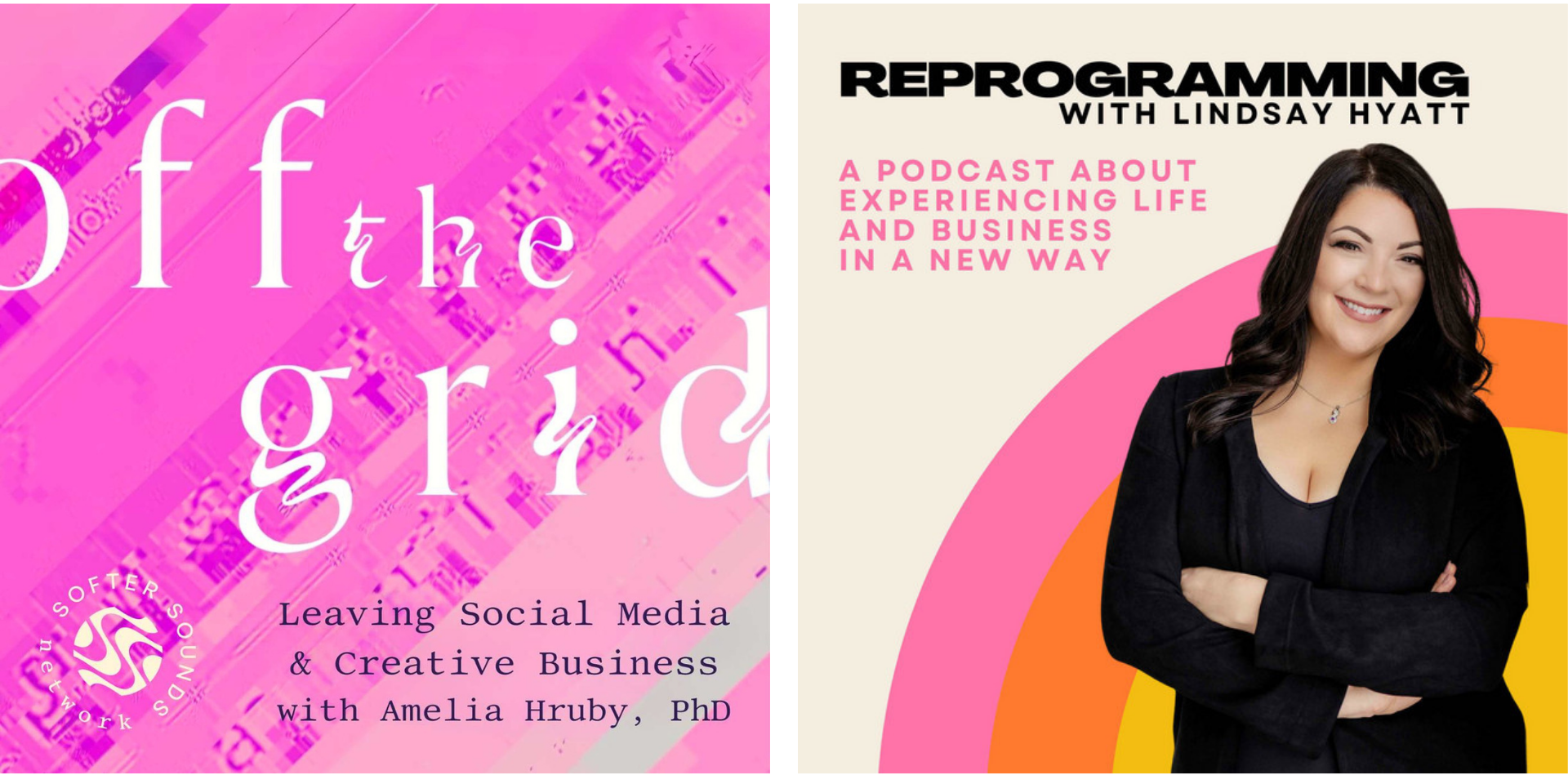
Hosting a podcast is also an option, as Amelia and Lindsay demonstrate with their respective shows Off the Grid and Reprogramming. I asked Lindsay how she plans to promote the podcast without social. She said she includes it in her weekly newsletter and that, when clients meet her in real life, she expects that they may Google her and find it too.
Websites and static social profiles
Just because people are reducing social activity doesn't mean they're erasing their whole online presence.
Websites are overlooked as an important foundation for your work according to Seth Werkheiser. "Give them something to devour," he said, explaining that once someone does learn about you—in whatever way that happens—you want to let them dig into your work as far as they want to go. Without a web presence that you control and with low or no social activity, they'll hit a dead end too fast.
Related to websites, media entrepreneur David Reiter thinks you should also consider having "trailer profiles" which are social media profiles you don't use but that others can tag when they share your work on social. He explained how to do this in a recent newsletter. You include a bio, a link and some pinned posts so your fans can amplify you in a way that makes it easier for others to get to your actual website. Designer Deanna Seymour offers a whole service around this for people leaving Instagram, creating an info rich "static 9 grid" where people can learn about you, tag you and share your work without you actually having to be present in the app.
Deepening existing connections
The one thing everyone aligned on was spending more time on one on one connections. You already have a network, even if it's small. Service providers repeatedly told me investing in their relationships yields the best results for them.
Brett mentioned an example where a reply to one of his newsletters turned into a back and forth with an interested reader who later referred him for a job. Amelia said she's seeing the encrypted group chat app Signal gain popularity in her circles as well as good 'ol scheduling 1:1 calls. And Brian reaches out to his core network one on one regularly via email. When he releases the new book, he's hoping that some of these strong connections turn into solid word of mouth amplification.
Other channels I heard in my conversations included private communities, hosting events, blogging, SEO, buying ads, and newsletter swaps.
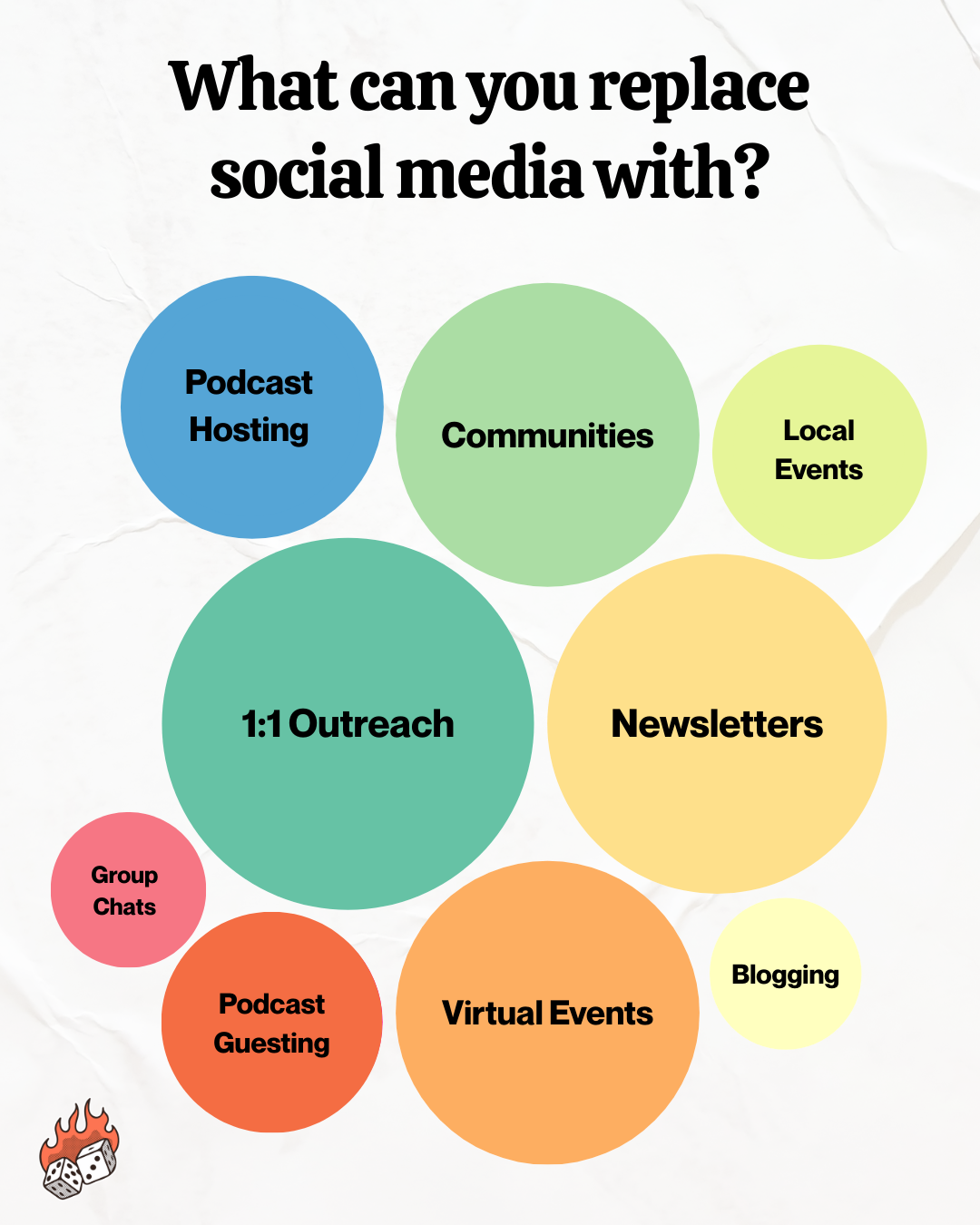
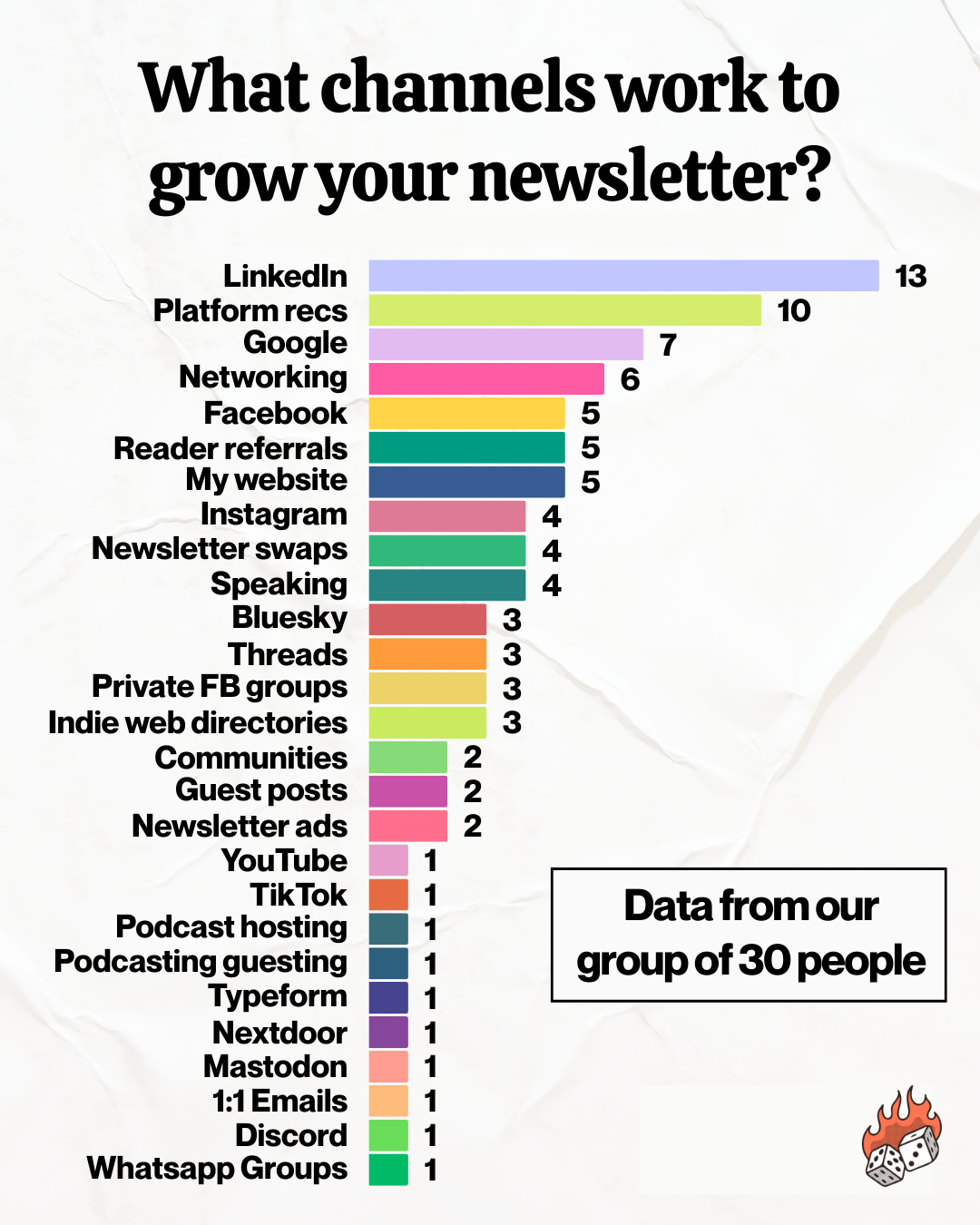
Social media alternatives I heard in my interviews for this story (left/top) and newsletter growth channels from our recent event (right/bottom)
What to consider if you stay
If you're reading this thinking, wow, good for all those people but that's not me. I've gotta stay, you're not alone. I too am addicted to all things social media and have only gone more online in the last year, adding Threads to my stack and expanding my post frequency on YouTube, TikTok and LinkedIn.
But hearing what's opened up for these entrepreneurs post-social gave me renewed energy to challenge my own behavior.
It's easy to get lazy with your marketing when you're super active on social because even booking one client on a channel or receiving an interested DM can make it feel like you're getting a good return on your time. My biggest takeaway from my interviews was that your personal relationships will always be both more meaningful and more fruitful than passing connections in the feeds. That's not to say that you can't begin those relationships on social—I've met most of my real life close friends through Twitter and TikTok—but you'll always be better off spending time with those people you already know versus tossing lines out all over the internet in hopes you catch fresh fish.
One way to make this easier to execute is to pair down your social channels. Sarah Giffrow recommends "focusing on just one social platform that's a really good fit" and not feeling pressure to conform to a place where you hate making the type of content it demands.
Beyond the business results, we do need to pay increasing attention to bad actors and invisible surveillance, whether it's from the government or from individuals. Maybe it wasn't that dangerous to post a photo of your new house on Instagram in 2010 but now we have several documented cases of people using a single photo to figure out where you live or work. In their 2026 marketing predictions episode, Amelia and Amanda Laird talk about the tension between maintaining your privacy online and building in public, which has been a popular audience growth method since The Lean Startup hit bookstores in 2011. It's good to be transparent with your audience, no matter the channel, but you don't have to blast out every single answer to your password security questions to build trust. Be mindful of how the info you put out could be used against you. The more public you are, the more people could be watching you, and worse, tracking you.
I don't see social media going anywhere but I do see a tear in the fabric of the networks coming soon.
It was once possible to post a lame graphic on Instagram and drive leads for your business. Those days are gone now that social media creators have become a $37B industry. If you're sticking around the social networks, you're going to be increasingly forced to produce higher caliber content, which at some point will drive you to decide if you want to get paid for that or if you'd rather find other ways to market your core business. Some of us will choose to make social media our job. The rest of us will close this chapter and move to alternatives.
One thing is certain, whether you stay or go, you do not need social media to grow your business. Plenty of people are succeeding without it. It's fully replaceable, as the entrepreneurs I spoke to have exemplified. Your options for audience building are infinite and the upside of reducing social just might be far sweeter than the sugar high of an endless scroll.
Resources for leaving social media
- Amelia Hruby's Off the Grid podcast and writings
- Seth Werkheiser's Social Media Escape Club
- Lindsay Hyatt's Get TF Offline Guides
- Brett Freeman's Unsocial newsletter
- Amanda Laird's Decelerator program
- Author Blair Glaser on marketing a book without social
- Mandy Maddela Hoskinson's in-person networking tips
- David Reiter's guide to making trailer profiles
- Deanna Seymour's static 9 grid service
- Cody Cook-Parrott's work on the practice of attention (mentioned by Seth)
- The Opt Out Project from Janet Vertesi
- Stephanie Imani LaFlora on building your tight circle
- Aggressively Human episode on "should I stay or go" re: social
I checked my social feeds at least 78 times while writing this story 🫠