
I vividly remember when the Russia-Ukraine war began. I was on Twitter when the news broke, and amid the flurry of urgent information about what was going on, I spotted one tweet aimed at me. It read:
"Marketers, you'd better unschedule your email marketing for tomorrow."
I did as advised. I unscheduled my email. Waited a couple days. Scheduled it again.
This was far from the first time I had wondered whether it was ok to keep marketing during [insert crisis here] but it was the first time I noticed the scolding aimed at small business owners. Now, every time breaking news takes over the feeds—roughly every one to two days—I see it again.
"How is everyone just marketing like nothing's going on???"
I wanted to know how other entrepreneurs think about this. The pressure is mounting on small business owners to do the right thing, but there's wild variation in what that means in practice. For some, it means speaking up as much as possible. For others, it means being a respite from the political chaos.
I reached out to a range of entrepreneurs who've been affected by recent events in Minneapolis, Portland, Venezuela, Lebanon, and Jordan to hear how they decide when to pause promotion and when to speak up.
Don't stop. Do both.
Kalyl Kadri has an unfortunate amount of practice balancing his small business marketing with major catastrophes. Kalyl's an unapologetically dramatic copywriter with a theater background who, by day, writes the best sales pages I've ever seen grace the internet and, by night, shines a light on injustices around the world.
"The majority of my life was lived in Lebanon where crisis was kind of a constant. We're always in conflict. The 2006 war. The port explosion in 2020. There's always something happening and crisis is a part of our day to day," Kalyl, who now lives in Barcelona, told me. "There's no use in me stopping marketing."
Kalyl generally keeps his marketing going no matter what's happening. He manages to promote his sales page offers alongside speaking up about Lebanon, Minneapolis and other horrific events. He said it's easiest to do this on Threads because it moves so fast. Posts hang around on Instagram longer so he thinks a bit more about what he shares there. His grid is all business while stories can sometimes include current events.
It's important to Kalyl that he attracts values aligned clients and members so there is a strategy to his political messaging too. He believes people should use their platform—whatever that platform might be—to amplify voices that aren't being heard and to speak on important issues. Because he's doing this all the time, his small business audience is used to it, and even attracted to it, because it signals they've found a safe space.
Know what your audience is feeling
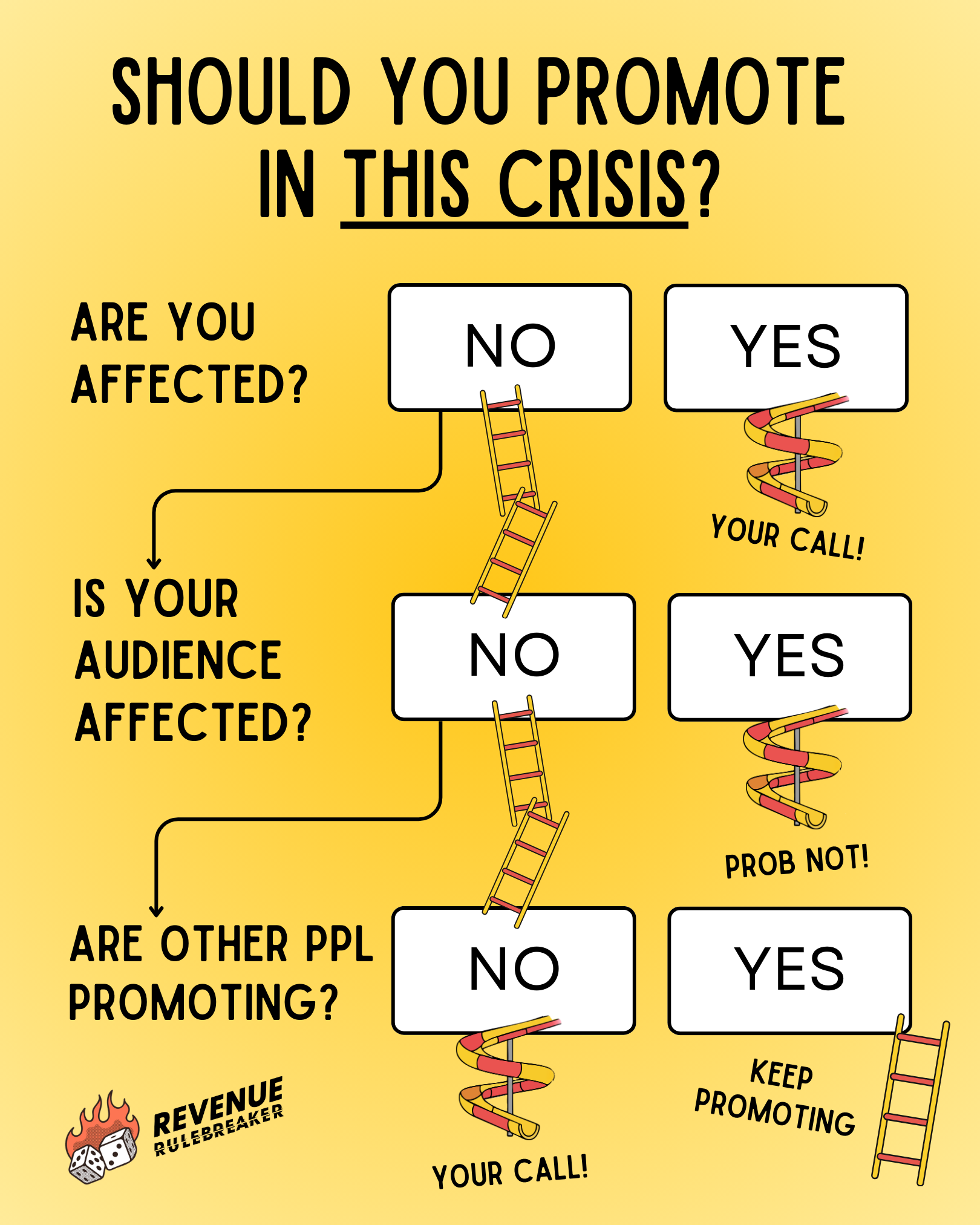
If a crisis directly affects you or your audience, it can become more obvious that you need to exercise caution with your marketing plans.
I spoke to two business owners from Minneapolis who had similar experiences in the last few months as ICE targeted their city. They felt like, even if they could stomach pressing forward on promotion, it wouldn't land well with their audience.
Jordyn DiOrio, who recently started a paid newsletter called Market Maven which decodes what's happening in the market for small business owners, told me she held the launch of this new project for a few weeks because "it felt tone deaf to ask for money." She redirected that energy towards a local organization, offering free consulting and resources to her hometown instead.
For Amber Hanson, the ICE raids heightened what has already been a stressful time for her clients and her business. Amber runs an anti-diet nutrition practice in Minneapolis. On top of the raids and protests—which began in December 2025—her clients were fearful about changes to U.S. health insurance which could affect whether or not they could still work with her.
"I have several clients on state medical assistance/medicaid so there is concern about changes to coverage and delayed payments every time the Trump administration talks about cutting medicaid benefits to Minnesota," Amber said.
Amber's had to spend a lot of time responding to these sudden policy changes in order to assuage her clients' concerns. It's a lot to take on, and to make matters worse, she recently lost an important freelance gig due to corporate layoffs and re-orgs: "It’s a strange balance of trying to remain a stable presence for clients while acknowledging the reality on the ground, and not panicking over personal finances."
Email copywriter Lib Aubuchon has witnessed the shift from automatically holding all marketing to making your messaging more situationally aware. Lib was working as a social media manager when the Sandy Hook shooting happened and recalled the immediate halt of all promotions at the time. Now that she runs her own business and advises clients on marketing strategy, she crafts the messaging to suit what her audience might be dealing with, rather than pausing altogether.
"I try to take proximity into account: How close is this crisis to my community? How are they being affected? I also consider tone. Is anything I've planned going to land wrong? Is there room for misinterpretation? I adjust from there," Lib said.
On the other side of the audience sensitivity spectrum, Théo Delazay, an independent video game journalist based in Paris, thinks of his platform like the games he covers: as an escape from real life. He rarely addresses anything political on his social media or newsletter channels, saying "You don't want to give people the impression the crisis will follow them everywhere they go."
Stay focused on your industry
For some entrepreneurs, it makes more sense to get political when it directly affects their chosen industry. But even those lines are getting more blurry.
"I don't talk about politics. It's generally been my position not to do it because I don't think it's actually of any benefit to me or the community. But I'm starting to think differently about it," Tommy Geoco wrote me.
Tommy's a designer, content creator and media studio founder who has moved into the AI space in recent years. AI is in the news so frequently and it's changing so fast that he feels it's becoming his obligation as a thought leader in the field to step carefully. "It's become a bit clear to me that I can't really expect to report on and discuss AI the way I want to without actually addressing the politics surrounding it," Tommy said.
He noted that he doesn't see himself as a journalist but he's looking to journalism and related models for how to ethically share information, especially because he has a sizable audience of at least half a million followers across channels.
Arturo Perez shares Tommy's sentiment to keep the political conversation tightly focused on the industry. Arturo runs a VR and AR gaming studio and generally, his company stays out of current events, except when it intersects with their games.
Arturo grew up between Venezuela and the United States. Several of his partners and teammates are also Venezuelan, though most do not live there anymore. I asked him whether he or anyone on the team felt the need to make a statement about what's going on in Venezuela (either now with Maduro being captured by the U.S. or at any time before since Venezuela has been in a state of crisis for decades now.) He told me, “The Venezuela conversation happens more when Venezuelans are together in a Zoom call than anywhere official. When I was living in Venezuela in 2010, the situation was talked about more daily [privately with the team.]”
Arturo does engage publicly in the politics of the gaming industry on LinkedIn, like layoffs and major tech pivots that affect how they operate, though he's fairly cautious about it. Behind the scenes, his team pays attention to global news when it comes to the musical artist packs they release alongside their games.
“There’s been a few instances when we haven’t chosen an artist or music pack, or held off on launching something, because that artist is going through the middle of a controversy,” Arturo said. In those cases, they don't make a public statement. They discuss the situation internally, choose whether or not to proceed and often end up releasing the music pack with a bit of a delay once the news cycle dies down.
Tie it into your mission
One way to balance marketing with your humanity is to design your business around our messy modern moment.
For journalist Yulia Denisyuk of Going Places, navigating the complexity of the world is the foundation of her business. She launched her brand with the mission to decolonize travel, center Indigenous voices, and recognize the interdependency of all who inhabit the Earth. Yulia produces global stories and also hosts guided trips—one of which is bound for Jordan this June.
I asked Yulia about how she's handling the escalating violence given her connection to the region and her upcoming trip. She said it just demonstrates how important it is to continue bringing people to Jordan. Her travel team is waiting to see that it is safe to run their trip, and if it is, it will proceed: "I want to say this to people, 'This is why you need to come now. This is why this is important.'"
She also acknowledged that this isn't normal and it's very difficult to operate when you have loved ones facing intense daily violence.
"I've had this feeling for many years now that yes, you can be in your lane, you're a traveler, you're an entrepreneur, you're talking about whatever, but at some point we're all humans showing up and witnessing all of these things. I feel like that's part of the problem, that people are just continuing as if nothing's happening," Yulia said.
Yulia doesn't believe there is such a thing as business as usual, and at the same time, she's feeling the financial repercussions of running a business that's willing to engage in deep political conversations: "I have been struggling for years now because I've lost contracts."
The cost is real but, for business owners like Yulia, there's no other way to operate than to deal directly with what's happening in the world.
Speak when it's on your heart
You may not need a framework to determine your promotion during politics strategy. Some entrepreneurs use more intuitive methods to decide when to speak on an issue.
"Nothing ever feels safe to be scheduled," Annie Liao told me when asked how she decides when to promote her work vs. not. It's more of a day to day call whether or not it feels right to market her business on public channels like LinkedIn and her email newsletter.
Annie is a workplace culture expert and operations consultant. She's often physically in a room with her clients and she always acknowledges out loud that everyone is "showing up with all kinds of things on our minds and hearts" as a way to set the group at ease that their humanity is recognized.
"At every moment in the day, there's joy and pain somewhere in the world. I think to be fully human, you have to live your experience, while also being mindful that there's a lot of other people around you that are experiencing vastly different things," Annie said.
As for marketing her work, Annie primarily leans on smaller communities now where it's easier to talk business no matter what the day's events bring. She doesn't use social as frequently because it competes more with urgent crises, and as a sensitive person, that becomes harder to balance.
Systems strategist Devin Lee also operates in a heart-led way when it comes to bringing politics into her work. Devin's cautious about speaking on anything outside her chosen expertise, but some issues are important enough to her that she will say something. One of those is transgender rights because Devin works with a trans advocacy nonprofit. "Life and business are intertwined," Devin said, explaining that she always tries to tie it back to what her clients come to her for: systems strategy. While there are many issues Devin cares about personally, shifting attention to a crisis is a rare exception on her business channels reserved for those moments when she really knows she must speak up.
There's no right way
You can't win at this game. It can harm your business to be vocal about politics. On the other hand, it can turn people off if you never speak up on an issue they care about, especially if it directly intersects with your work.
Most business owners I spoke with leaned towards keeping their business channels focused on business, but every one of them had a line where business becomes political. You have to decide on your own internal framework so you can make decisions day to day. Do you only speak on industry issues? Local issues? Or do you keep politics out of everything? No one can set this bar for you but it's good to be aware of who it might attract or repel. There's no such thing as neutral.
What businesses are expected to speak up about swings wildly year after year. We see major corporations wait for that inconsistent public pressure to do anything and then crawl back into their shell when it dies down. For small business owners, the politics of promotion is a more linear trend. A more personal one. It's a new mode of operation where business owners find their own internal line of how much humanity to bring to work. That line is shifting with every crisis.