
When I pitched the idea of a creative collective to my lawyer, he took a deep breath. “I can write the contracts,” he told me, “ but I don’t think this is a good idea.”
I tried to explain it differently, thinking he just didn’t understand. “I mean, it’s really an agency if you think about it. But the leads are coming from multiple business owners,” I said (pleadingly).
“Yeah, but you’re the one taking on the liability. If something goes wrong, you’re on the hook,” he explained patiently.
“But isn’t that all business?” I asked.
I got him there. And after some back and forth, he drew up the client and member contracts, filed the LLC, and sent me the articles of organization.
On May 2, 2022 Strange Salt: A Creative Collective was born.
The idea was simple enough. A curated group of creative business owners would come together to pitch bigger projects when it made sense. And when it didn’t, we’d go our separate ways and work on building our own businesses. We believed that a rising tide would raise all ships, and we sought to put that idea to the test.
Sounds pretty dreamy, right?
I get a lot of questions about starting a creative collective. What’s it like? How does it work? What would you do if you were starting over? But people aren’t asking the question I wish they’d ask:
Is it working?
I want them to ask because the answer is no, it’s not.
And *REVENUE RULEBREAKER EXCLUSIVE* I silently closed the collective this fall.
But I think it could have worked with more thought, more structure in some places, less structure in others, and *gasp* more collaboration.
If I were building it again, here’s what I would do differently.
I’d be more of a capitalist.
When I started Strange Salt, I knew I couldn’t simply be a pass-through for work and had to charge a markup on the services rendered. As much as I wanted for everyone to simply get paid for their work, I wasn’t oblivious to the fact that just by covering the credit card and processing fees for a single project would put me in the red.
I also knew I wanted to keep the cost accessible for early-stage founders and small business owners. So, I kept the structure simple—15% markup on all services rendered, and that would all go to overhead expenses.
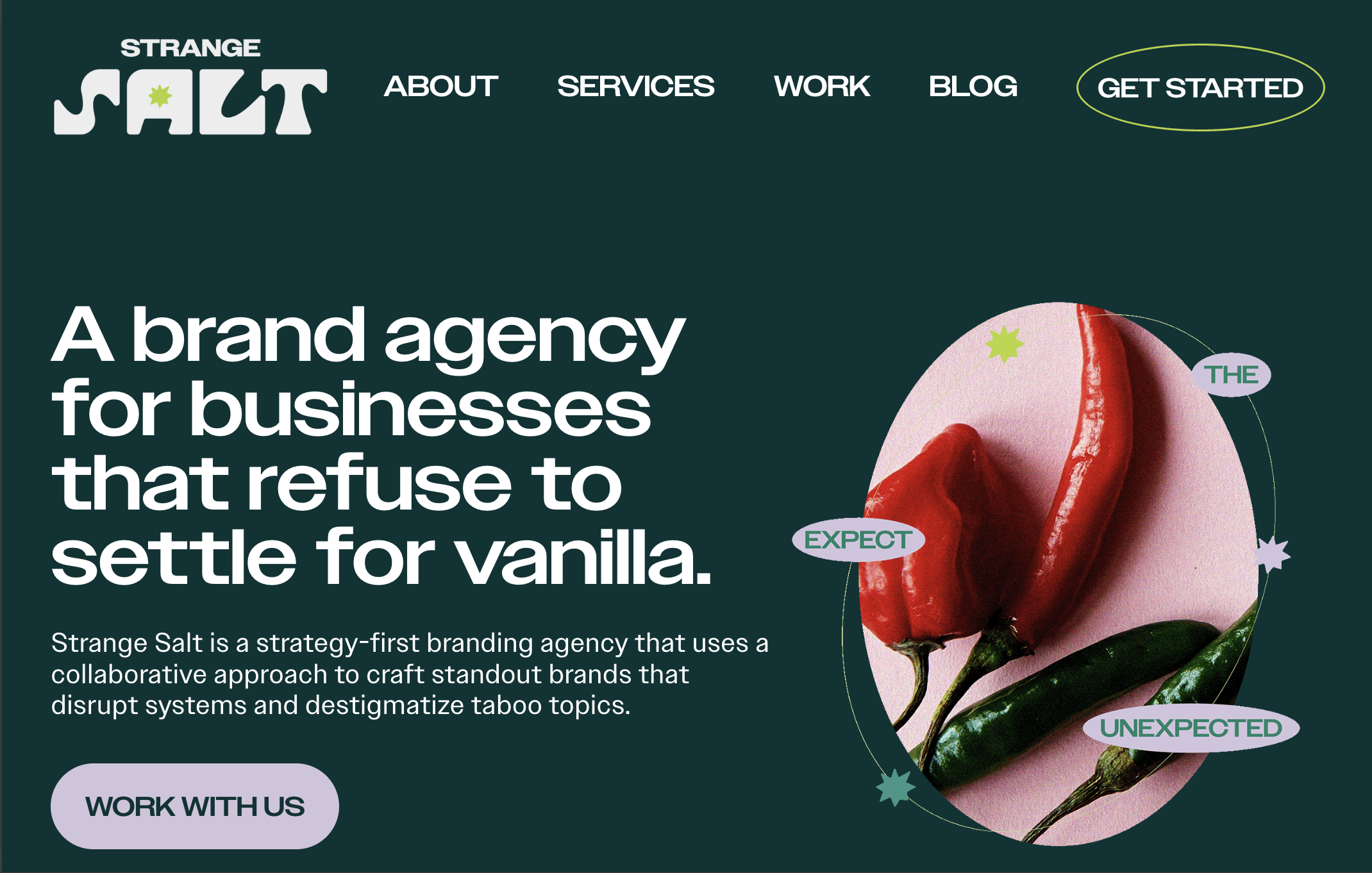
Our first won project was $25,570 and included three Strange Salt members: Liz Talago (messaging strategist), Sara Strese (visual identity and web designer), and me (brand strategist/account lead). It was the largest project I’d pitched so far, and while I personally made $5,000 for the brand strategy portion of the project (I definitely underpriced my work at this time!), I didn’t account for the amount of work managing a team of contractors was, versus managing just me in my other projects.
This was hours of both active and passive work. It included doing calendar gymnastics to schedule seven people across multiple time zones in a four-hour workshop, learning our members’ processes so the work happened as seamlessly as possible, and constant internal Slack pings to make sure we were on schedule to deliver when we said we would. And that was just in the first round of the first phase of work. Throughout the project, I was the person filtering feedback from the client to our members. I’d done this as a Creative Director and had gotten pretty good at it, but I found myself getting sucked back into some of the responsibilities I’d hoped to leave behind. Even with the 15% markup, this one felt like a loss for me. Strange Salt’s take was $3,835.50 from the project.
I pressed on, making some small adjustments here and there on the few (very small) additional projects we got that year. At the end of 2022, we’d pulled in $33,450.00 in revenue. $31,254.88 of that went to expenses (mainly paying members for their work, plus the aforementioned legal fees and other business set-up expenses). At the end of the year, the business was technically profitable with a cushy $1,395.12 sitting in our bank account.
I was happy that I got paid for my work and contributions (kind of) and that members got paid for theirs.
That was, until annual subscriptions, insurance premiums (a new line item), and taxes rolled around. I heard my lawyer’s words ringing in my head, “But you’re the one taking on the liability.”
It wasn’t a collective of people stuck with bills—it was me.
Which brings me to my next point…
I’d structure membership differently.
The clear benefit of being a member of Strange Salt was that you got work you may not have gotten otherwise. You didn’t have to manage the project, you didn’t have to touch the stuff you didn’t want to, and you had full autonomy over which projects you took on (as opposed to an agency, where you’re just assigned whatever work comes to you).
We had a loose membership agreement. It included some details about the LLC’s responsibilities (connecting clients to the members) and a note that we wouldn’t place any restriction on the work they did outside of our projects.
Reading this agreement today, I realize there’s no responsibility or expectations on the members.
My momma lawyer told me there’d be days like this. The cost to join Strange Salt? Good vibes.
I was selling one part of the collective short: the quality of its members. With this in mind, I’d think differently about membership and would explore some of these opportunities:
- Annual membership dues. This would be a nominal fee to join Strange Salt. It would help me cover day-to-day costs and allow me to increase member engagement through things like networking members to help people connect and workshops with industry experts that would help them build their business. By paying dues, members would have a profile on our website (many leads bypassed Strange Salt completely and used us as a roster to find talent), access to a “leads board” where they can see open inquiries and submit proposals, and access to all events. This model would have brought the community element to the forefront, making the client work more of a “bonus.” I believe this approach would have supported the idea that a rising tide raises all ships a bit better by increasing member engagement, business growth, and buy-in.
- Membership tiers. In this model, there would be tiers to join Strange Salt. These tiers would support business owners who were learning (lowest fee with access to events), growing (a higher fee with access to work opportunities), and sustaining (highest fee with everything plus voting power in moving the collective forward). This tiered approach would also include expectations (like bringing at least one lead to the table at a higher membership tier). 2022 Jamie couldn’t fathom this structure, and even today, it makes my head spin a bit.
Both of these approaches would require more day-to-day management and put me in a position of both business development lead and community manager. Something I didn’t have the bandwidth or headspace to do.
Unless…
I’d go all in.
I started Strange Salt as a spin-off of my own business. While I was building Strange Salt’s business and brand, I was simultaneously building my own as an independent brand strategist.
The overlap between the two was pretty large. A client would come to me looking to build their brand. When I listened to their problems, I realized they needed a more full-service solution that included strategy and implementation (whether it was design, website development, or marketing management). Making the transition from wanting to work with Jamie to wanting to work with a group of people that includes Jamie was rough.

Because my personal business focused on supporting early-stage founders (at the time), their budget didn’t account for hiring a full team. They needed a freelance-esque partner to help them get moving. The overlap between my individual work and the collective’s work seemed too great to build two distinct brands, which often left me trapped in a flow chart with two diverging paths: Does this client go to Jamie or does it go to Strange Salt?
Members experienced this too. One of the frequently asked questions from members was, “How do I introduce you to a great lead when they’re already set on working with me?” I didn’t want to jeopardize the member’s opportunity to get the work by adding a layer of complexity, so it was always a tricky thing to navigate.
I am constantly encouraging others to full ass one thing (at least to start), and I wish I had taken my own advice.
By going all in on Strange Salt and dropping my personal practice, I could have afforded myself more flexibility to do solo projects (under the Strange Salt brand and legal entity) and flex up to include more folks when it made sense. The handoff between Jamie and Strange Salt would have been a lot smoother because there wouldn’t have been one to begin with. By solving this problem for myself first, I could have also created better structure and processes for members to follow for the hand-off as well.
Going all in would have put a more hierarchical structure in place, with business development efforts falling to me. In this scenario, I start to question if I was even building a collective or just building the agency I’d escaped years earlier and calling it something different.
So maybe I wouldn’t do it at all.
As I move into this post-Strange Salt world and go all in on all things Jamie R Cox, I’m still doing brand strategy and pulling in support from the former collective. I ask Sara to build a visual identity that supports my strategy, and I ping Liz for help facilitating workshops. I refer great people to great clients (and occasionally get a little referral bonus if I ask nicely).
This work is still happening; it just doesn’t have a separate container. By going all in on me, I’ve found it’s easier for me to market my work and build on the brand equity I already have. I’m carrying less of a burden by feeling beholden to members (who never really expected anything from me, if I’m being honest with myself), and I’m able to be more nimble in a world where change is constant.
Building a business is lonely, and building something together was really appealing to me. But the complexity it brought I got me further and further from the flexibility I was looking for when I built my own business. I’m not saying don’t build a creative collective. But I am saying I’m not the person to build it.When I wrote about “my lawyer,” I was talking about one of my best friends who happens to be a lawyer. I might not be willing to admit I was wrong to my lawyer, but I am willing to admit it to my friend.
And Dustin, I was wrong.
Lucky for me, nothing went wrong with Strange Salt. But nothing really went right either.
Find Jamie R. Cox on her website, get her newsletter "Brand Burnout" and follow her on LinkedIn.